Category Archives: television

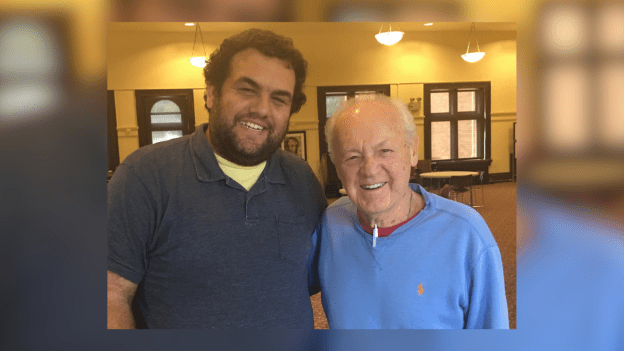
Remembering Joe Negri, and the afternoon I interviewed a childhood icon

Joe Negri, the jazz guitar virtuoso beloved by generations as Handyman Negri on “Mister Rogers’ Neighborhood,” died May 30, just days shy of his 100th birthday. He was 99.

For many, Negri was part of the fabric of childhood television — a kind, steady presence in the Neighborhood of Make-Believe who could sing, play guitar and offer a little help when help was needed.

On the show, he appeared as Handyman Negri and as the owner of Negri’s Music Shop, a fitting role for a real-life Pittsburgh musician. Fred Rogers Productions describes him as a jazz guitarist and “friendly neighbor” whose music shop helped introduce a wide variety of musical guests to the show.

But in Pittsburgh, Negri was more than a familiar face from television. He was a musical institution — a gifted guitarist, teacher and performer whose career stretched across decades.

I knew all of that when I met him in 2017.

Still, none of it prepared me for what it felt like to sit across from Handyman Negri.

At the time, I was editor of The Signal Item in Carnegie. Negri was scheduled to perform at the Andrew Carnegie Free Library & Music Hall, and the library’s then-director, Maggie Forbes, arranged for me to interview him at the library.

Some interviews stick with you long after the story is published.

Meeting Joe Negri in 2017 was one of those moments.

It remains one of the top memories of my time at the Tribune-Review and of my career as a journalist.

He was, after all, a childhood icon.

For anyone who grew up watching “Mister Rogers’ Neighborhood,” the people who appeared on that show were not simply performers. They helped build a world where children were spoken to gently, taken seriously and reminded that they mattered.

Our interview went much longer than either of us had expected. At one point, Maggie came to check on us, likely wondering how a simple interview had stretched into something closer to a visit between old neighbors.

Negri was sharing stories about working on the show and, of course, about Fred Rogers.

“They brought Fred over to WTAE where I was the musical director,” Negri told me in 2017. “He was going to start a ‘Mister Rogers’ Neighborhood’ for 15 minutes. It was a prototype of what the show became. He opened it up at the piano. Then he went via the trolley into the neighborhood. The station put me on the show to assist with the music.”

Negri said he already knew Rogers a bit from the early days of WQED.

“He worked with Josie Carey, who was a good friend of mine,” Negri said of Carey, who was a well-known host of children’s television shows. “We worked together very well.”

What began as a music role slowly became something more.

“Little by little, he would say to me, ‘Why don’t you walk around the neighborhood and talk to the puppets,’” Negri said. “That’s what Josie used to do in the old ‘Children’s Corner.’ So I would walk around and talk to King Friday and X the Owl, Lady Elaine Fairchilde. It was fun. He and I hit it off and the show was good.”

But Rogers, Negri recalled, resisted pressure to turn the show into something commercial.

“The sales department wanted him to sell products. And he didn’t like the products,” Negri said. “He wouldn’t sell GI Joe. He wouldn’t sell food he didn’t believe in, like cereal with sugar. So he fought with the sales department, and within six months he was out of there.”

A year later, Rogers called him.

“He said, ‘Would you like to be the handyman?’” Negri recalled. “I said, ‘I think you’re kidding. You’re picking the wrong guy.’ I wasn’t a good actor, and I wasn’t a handyman.”

He laughed when he told that story.

“It worked out alright,” he said.

It certainly did.

Negri remembered the guests, too.

“We had some wonderful guests,” he told me in 2017. “I remember the Wicked Witch of the West from ‘Oz,’ Big Bird.”

Sitting there with him, I was struck not only by the history he carried but by how graciously he carried it. He was generous with his time, generous with his stories and generous with the emotions people brought to him because of the show.

At one point, I told him how much “Mister Rogers’ Neighborhood” meant to me. Then I apologized, saying I was sure he heard that all the time.

His response has stayed with me ever since.

He told me he loved when people shared their memories with him. To him, it meant the show had done its job. It meant people had been moved by it.

That simple answer captured so much of what made Negri, Rogers and that neighborhood so special. They understood that public broadcasting and children’s television could do something lasting.

When the interview ended, I walked back to my car and cried.

Not out of sadness, exactly. It was gratitude, nostalgia and the overwhelming feeling of having met someone who had once seemed to live only inside the television set. It was the emotion of sitting with a person connected to something that had helped shape me, then realizing the kindness I remembered from childhood was real.

You should care more about the Nexstar/Tegna merger than you do

You should care more about the Nexstar/Tegna merger than you do because it will have an impact on you — and it won’t be good.

A friend who still works in news texted me this morning after the Nexstar/Tegna merger news: “You got out at the right time.”

I had already been talking with two other friends about the merger — one who works in news and one who also got out — when she messaged that.

Her words really struck me. Leaving journalism is something I wrestle with far too often.

I miss following stories that actually affected people’s lives — directly and indirectly, and in ways they did not even realize.

I miss knowing more than the average person about what was happening in local government, in schools, in neighborhoods, on roads people drive every day.

I miss asking elected officials very basic questions and watching them get annoyed that someone was paying attention.

I miss all of what news was.

I left full-time journalism at the end of 2022.

At the time, I was working for a television news company, but none of this happened overnight. I had seen the shift starting years earlier — even a decade earlier — as people became more hostile toward local news and as newsrooms slowly started prioritizing things other than the news itself. For me, 2020 felt like a tipping point. That is when everything already in motion seemed to move into overdrive.

Important news was still getting covered. Real journalism was still happening.

But as attention spans waned and eyeballs wandered to other forms of media (like TikTok, Instagram, YouTube), the draw to make headlines more sensational, videos shorter with less information and more gimmicks only intensified.

And it was not just happening in TV. It was happening everywhere.

There appeared to be less emphasis on actually informing people and more emphasis on feeding the machine.

More and more news outlets were referring to news as “content.” And that “content” included links to Amazon products, useless user-submitted photo galleries, rewritten news releases and archived video made to look like something new.

And, I need to note, good journalism is still out there. People are still fighting to do quality journalism every day.

But too much of it is buried under junk, largely driven by the powers that be (typically, people who just have money to buy a news outlet or a few and have no actual concern about the news — or people being driven by those demands).

Maybe my friend is right. Maybe I did get out at the right time.

But I still go back and forth. Some days, I feel like I let news down by leaving. Other days, I know I was protecting myself by stepping away from a fight that already felt lost.

Hourglass / Image by Eduin Escobar from Pixabay

From Drake Hogestyn to John Black: End of an icon on ‘Days of our Lives’

John Black’s death on “Days of our Lives” hit hard—not just because we lost a fictional hero but because of what it meant for the people who knew and loved Drake Hogestyn.

For nearly 40 years, John Black saved lives, beat the odds and always came home to Marlena. But his final act of heroism—saving Bo—was one he wouldn’t survive.

John Black was the heartbeat of Salem—the other half of one of daytime’s most iconic couples, and a dependable constant through the wildest soap storylines imaginable. Watching him take his final breath wasn’t just painful—it felt personal.

The way he died was classic John Black: Heroic, self-sacrificing and driven by love for family.

He fought to get the medicine Bo needed, making it back from another secret mission just in time to help Steve and Shawn bypass the lab’s security system. That final act was pure John Black—saving a friend no matter the cost.

Bo lives because of John Black, and in a way, that legacy is fitting. John always put others first. But knowing that his final moments were—in some manner—also a goodbye from Drake Hogestyn makes it even harder to watch.

Drake Hogestyn last appeared on the show in September and died a few weeks later following a diagnosis of pancreatic cancer, which he kept away from the public spotlight. “Days of our Lives” films about eight months ahead, so, at the time, Hogestyn was leaving the show for medical reasons, likely planning to return.

He approved the storyline of John Black’s death, and that’s what makes this even more gut-wrenching.

Eric Martsolf, who plays John Black’s son Brady Black, said filming the funeral scenes didn’t feel real.

“It felt very unnatural to film a funeral of a character and a man who you knew was still with us,” Martsolf said in an interview.

By all accounts, Drake Hogestyn was a mentor, a father figure, a steady force behind the show.

I don’t think we’ll ever see a character like John Black again. He and Marlena were the gold standard for soap supercouples. Their love survived death, amnesia, possession and plot twists that defied logic—and it still felt grounded.

We didn’t just say goodbye to a character. We said goodbye to a legacy.

‘Small Town Setup’ misses mark by forcing real women into Hallmark movie tropes

Hallmark Channel’s “Small Town Setup” wants to be the real-life version of its most beloved movie plot: Big-city woman returns to her quaint hometown, realizes she’s missing love and finds it — handpicked by her parents and neighbors. But what plays like a romantic fantasy in a movie script feels far more intrusive and problematic in reality.

The show, which airs only on Hallmark’s streaming service, is a cringeworthy framework that’s rooted in dated gender roles and small-town idealism masquerading as universal truth.

Here’s the premise, straight from Hallmark: “An unsuspecting city dwelling single returns home to visit their small town parents, and is met with three potential dates. These suitors have been carefully selected by their parents and community, hopeful they will find love.”

Translation: You’re single, so your life must be missing something — and your family, neighbors and a Hallmark+ crew are here to fix that for you.

In the first episode, Victoria — a successful businesswoman living in New York City — visits her small hometown. She’s met with the suggestion that her single status is a problem, not a choice. Her parents, in coordination with dozens of people from the town, have curated three men she might date. That’s not matchmaking — that’s social engineering.

The process? The town nominates men. The parents narrow the field to three. Victoria then goes on dates while 80 or so townspeople observe and vote. It’s part community fair, part bachelor auction.

Her first date brings lemonade to a lakefront chair setup. She tells him she’s open to moving back “for the right person.” Cue the stereotype: That love is best found by leaving your independent city life behind and retreating into simpler, slower surroundings.

The other two dates — one at a mini-golf course, one at a crepe restaurant — are awkward. The conversations feel off, as if Victoria is performing openness while being trapped in a format that doesn’t leave much room for agency. She asks both men about their five-year plans, but we never hear hers.

At the end, Victoria has to choose. But before she does, Ashley Williams (the host) announces who the townspeople voted for. Then we hear who the parents picked. Only then does Victoria get to make her decision — in front of everyone.

She picks Michael, the first guy. They smile for the camera. And then the show just… ends.

The second episode starts the same way — a New York City woman heads home while her family searches for “Mr. Right.” I turned it off within minutes.

There’s nothing wrong with valuing relationships or even believing in the magic of small towns. But “Small Town Setup” doesn’t offer a heartwarming story — it offers a narrow view of what happiness looks like, and it reinforces tired tropes that women need saving and success isn’t enough without romance.