Tag Archives: Carnegie

Remembering Joe Negri, and the afternoon I interviewed a childhood icon

Joe Negri, the jazz guitar virtuoso beloved by generations as Handyman Negri on “Mister Rogers’ Neighborhood,” died May 30, just days shy of his 100th birthday. He was 99.

For many, Negri was part of the fabric of childhood television — a kind, steady presence in the Neighborhood of Make-Believe who could sing, play guitar and offer a little help when help was needed.

On the show, he appeared as Handyman Negri and as the owner of Negri’s Music Shop, a fitting role for a real-life Pittsburgh musician. Fred Rogers Productions describes him as a jazz guitarist and “friendly neighbor” whose music shop helped introduce a wide variety of musical guests to the show.

But in Pittsburgh, Negri was more than a familiar face from television. He was a musical institution — a gifted guitarist, teacher and performer whose career stretched across decades.

I knew all of that when I met him in 2017.

Still, none of it prepared me for what it felt like to sit across from Handyman Negri.

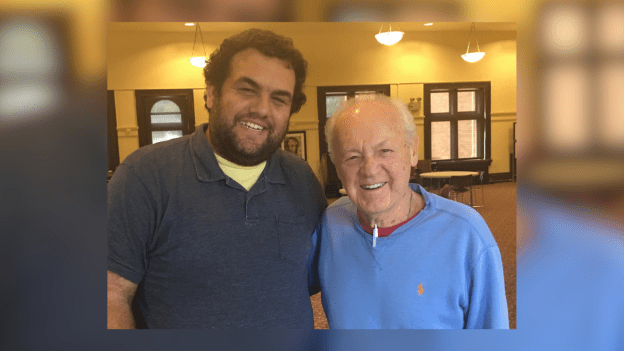
At the time, I was editor of The Signal Item in Carnegie. Negri was scheduled to perform at the Andrew Carnegie Free Library & Music Hall, and the library’s then-director, Maggie Forbes, arranged for me to interview him at the library.

Some interviews stick with you long after the story is published.

Meeting Joe Negri in 2017 was one of those moments.

It remains one of the top memories of my time at the Tribune-Review and of my career as a journalist.

He was, after all, a childhood icon.

For anyone who grew up watching “Mister Rogers’ Neighborhood,” the people who appeared on that show were not simply performers. They helped build a world where children were spoken to gently, taken seriously and reminded that they mattered.

Our interview went much longer than either of us had expected. At one point, Maggie came to check on us, likely wondering how a simple interview had stretched into something closer to a visit between old neighbors.

Negri was sharing stories about working on the show and, of course, about Fred Rogers.

“They brought Fred over to WTAE where I was the musical director,” Negri told me in 2017. “He was going to start a ‘Mister Rogers’ Neighborhood’ for 15 minutes. It was a prototype of what the show became. He opened it up at the piano. Then he went via the trolley into the neighborhood. The station put me on the show to assist with the music.”

Negri said he already knew Rogers a bit from the early days of WQED.

“He worked with Josie Carey, who was a good friend of mine,” Negri said of Carey, who was a well-known host of children’s television shows. “We worked together very well.”

What began as a music role slowly became something more.

“Little by little, he would say to me, ‘Why don’t you walk around the neighborhood and talk to the puppets,’” Negri said. “That’s what Josie used to do in the old ‘Children’s Corner.’ So I would walk around and talk to King Friday and X the Owl, Lady Elaine Fairchilde. It was fun. He and I hit it off and the show was good.”

But Rogers, Negri recalled, resisted pressure to turn the show into something commercial.

“The sales department wanted him to sell products. And he didn’t like the products,” Negri said. “He wouldn’t sell GI Joe. He wouldn’t sell food he didn’t believe in, like cereal with sugar. So he fought with the sales department, and within six months he was out of there.”

A year later, Rogers called him.

“He said, ‘Would you like to be the handyman?’” Negri recalled. “I said, ‘I think you’re kidding. You’re picking the wrong guy.’ I wasn’t a good actor, and I wasn’t a handyman.”

He laughed when he told that story.

“It worked out alright,” he said.

It certainly did.

Negri remembered the guests, too.

“We had some wonderful guests,” he told me in 2017. “I remember the Wicked Witch of the West from ‘Oz,’ Big Bird.”

Sitting there with him, I was struck not only by the history he carried but by how graciously he carried it. He was generous with his time, generous with his stories and generous with the emotions people brought to him because of the show.

At one point, I told him how much “Mister Rogers’ Neighborhood” meant to me. Then I apologized, saying I was sure he heard that all the time.

His response has stayed with me ever since.

He told me he loved when people shared their memories with him. To him, it meant the show had done its job. It meant people had been moved by it.

That simple answer captured so much of what made Negri, Rogers and that neighborhood so special. They understood that public broadcasting and children’s television could do something lasting.

When the interview ended, I walked back to my car and cried.

Not out of sadness, exactly. It was gratitude, nostalgia and the overwhelming feeling of having met someone who had once seemed to live only inside the television set. It was the emotion of sitting with a person connected to something that had helped shape me, then realizing the kindness I remembered from childhood was real.

Remembering Edith Hughes…

Unlike many colleagues and friends, my stories of Edith Hughes don’t involve what seemed to be a haphazard interview session or a layout filled with red ink corrections.

My first run-in with Edith came one morning in 2007 in the Gateway Newspapers former office on Greentree Road. It was early that morning — just myself and Signal Item editor Bob Pastin were in. Edith quickly zipped through the office, pausing just enough to look at me — a new face. She rushed into Bob’s cubicle and asked, “Who is that?”

Bob replied, explaining I was the new (at the time) part-time reporter for the Signal Item and Sewickley Herald. She came back out of his cubicle, looked at me as I awkwardly smiled at her — unsure of what just took place, and then she left.

The first time I spoke to Edith was in Harrisburg for a Pennsylvania Newspaper Association weeklies conference. Her first statement: “Did you get breakfast?” No, I said. She then looked me up and down and asked how I was liking the Sewickley Herald. Before I could finish a sentence, she said, “Interesting attire, young man.” I had on khakis, a polo shirt and tennis shoes — my usual work attire.

She then said, “Maybe you’ll learn something here to take back to Sewickley.”

What she didn’t know is that it wasn’t the guest speakers from The Patriot-News or any other newspaper that I’d learn from that day. It was Edith who would teach me more than I ever thought I could know.

You see, Edith had a way with more than just journalism. She had a way with life. In her eyes, good manners, proper attire and fine detail meant everything. You didn’t cut corners. You gave more than your best. And you did all of that out of respect for yourself, your talent and your colleagues.

I got to know her more through stories from colleagues and from her random visits to the Sewickley Herald office. She played a major role in the Herald’s annual honors dinner, recognizing the great community-minded individuals of the year. Place cards were handwritten, not typed. The menu offered nothing but the best food. And the entire evening was as perfect as perfect could be. Why? Because she’d settle for nothing less.

At one of the honors dinners, she looked at me and said, “You clean up well. I almost didn’t recognize you.”

In January of this year, I returned from a nearly two-week-long vacation. I had a missed call and e-mail from Edith. Odd, I thought. Out of the more than 20 voice mails and 200 e-mails, Edith’s were the first messages I responded to.

Days later, I heard from her. She wanted to talk to me in person. I was nervous, to say the least. She couldn’t fire me, she didn’t have that authority anymore. Right? But what did I do to be getting a visit exclusively from Edith?

I dressed a tad nicer than my average wardrobe (no tie, though), and awaited her visit. Snowflakes were flying. Edith called and said she’d be late. Finally, Edith arrived and whisked me away into the conference room where she shut the door.

“I need you to talk at the weeklies seminar about everything you do with technology,” she said. “It’s in April.”

This was early January — many months and inches of snow away from April.

“Yeah, I’ll do it,” I nervously said, scribbling down the words “April” and “PNA.”

“Yes, you’ll do it,” Edith said, either repeating what I said, but probably correcting my language.

She expected an outline by mid-February. I e-mailed her an outline by the end of that week in January.

The morning of the conference, Edith — oddly enough — was late. As it turned out, the massive rain and flooding from the previous day and night knocked the power out at her hotel. I stayed elsewhere in the Harrisburg area, which was unheard of in Edith’s mind because I did not get breakfast options at my hotel (though, she was impressed that I got a better room rate than she!).

Right before my turn to present, I completely re-did my entire presentation because the previous speakers took most of what I was going to say. Introducing me to the crowd, Edith explained what a dedicated and passionate reporter I was, and what I had done to help make the Sewickley Herald a newsier paper. I can remember standing there thinking, “Holy crap, Edith is saying this about me?”

Afterward, Edith told me I was the best presenter (even though I went over by 15 minutes). “That was some talk you gave” she said. “Even I was surprised. You knocked their socks off.”  She paused and said, “You’re already booked for next year.” I didn’t get a chance to agree because she grabbed a mint and walked away.

I wasn’t hired by her or even worked under her, but I still felt I needed her approval as a journalist. And I’m pretty sure I got it that day.

She didn’t make the Herald’s honors dinner this year because she was traveling. But I did sit next to her in May at the Keystone Press Awards, where she, again, spoke highly of my presentation a month earlier. At the Keystone Press Awards dinner, we talked about my presentation for next April and how she thought the awards dinner chicken was too dry and the speakers were mostly boring.

She, no doubt, has made a lasting impact on my career — and more importantly, my life. Thanks to Edith, I hold myself in higher regard and respect the decisions I make and the stories I cover, knowing that my name is on whatever story I’m writing at the moment, so it better be the best it can be.

“Reporters are a dime a dozen,” she once told me. That phrase has stuck with me, allowing me to remember what my job is and to carry it out with dignity and respect.

Edith made me realize just how important grammar and proper communication skills are, and to be poignant, sharp and decisive.

My world is a better place thanks to Edith.