Category Archives: Uncategorized

Pittsburgh showed up for the NFL Draft — and so did everyone else

Pittsburgh had its moment on the national football stage, and the region delivered.

I spent most of Friday and Saturday in Downtown Pittsburgh and on the North Shore, taking in the NFL Draft events, walking around, talking with visitors and soaking up a weekend that felt equal parts football festival and Pittsburgh pride.

It was a blast.

I started both days in Moon, parking at the park-and-ride lot and taking Pittsburgh Regional Transit’s Football Flyer into town. It was quick and easy. As a public transit fan, it was a great way to invite suburbanites and people who don’t think about public transit to experience a big event and skip the traffic, letting someone else handle the drive.

The bus rides became part of the experience. I met people from Ohio, Illinois, California, Washington state and New England. Some were staying in hotels around Moon, Robinson and the airport area. Others had driven in from Ohio for the day. There were Browns fans, Chargers fans, Bengals fans, Ravens fans (ugh) and, yes, even Eagles fans (boo!).

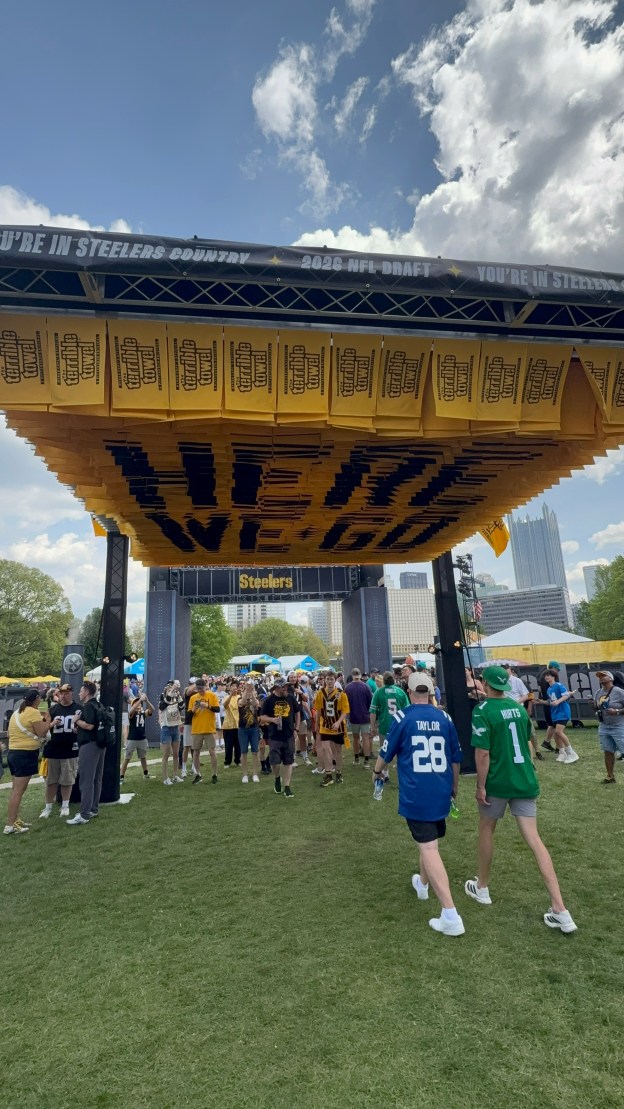
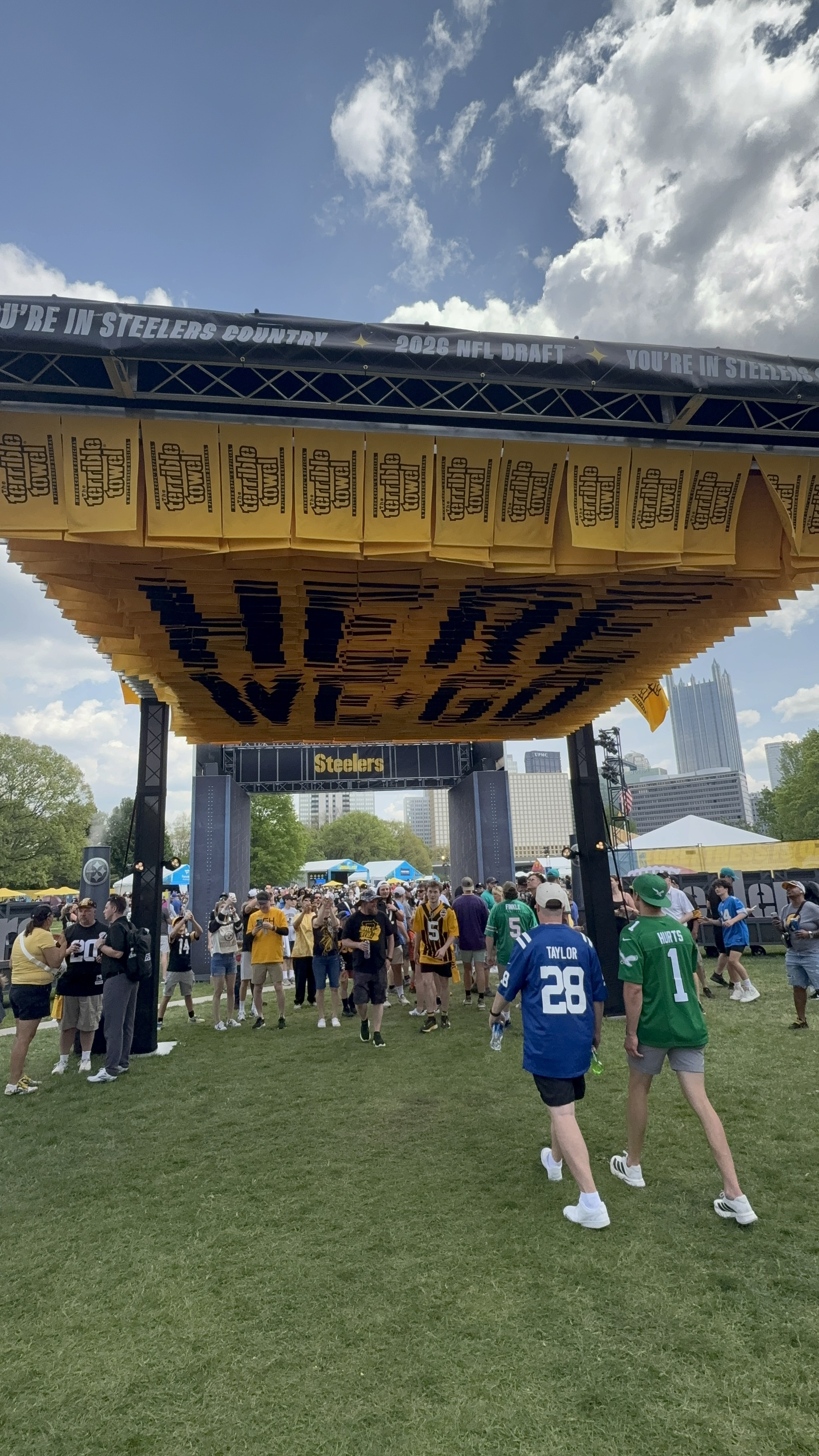
Terrible Towel display

That was one of the best parts of the weekend: Seeing so many different fan bases walking around Pittsburgh. Team jerseys, hats and shirts were everywhere — on the bus, Downtown, along the North Shore and even at the Sheetz in Moon. There is something funny and wonderful about walking into a Sheetz and seeing a mix of Steelers, Browns, Ravens, Vikings, Cowboys and Bengals gear all in one place.

That does not happen every day.

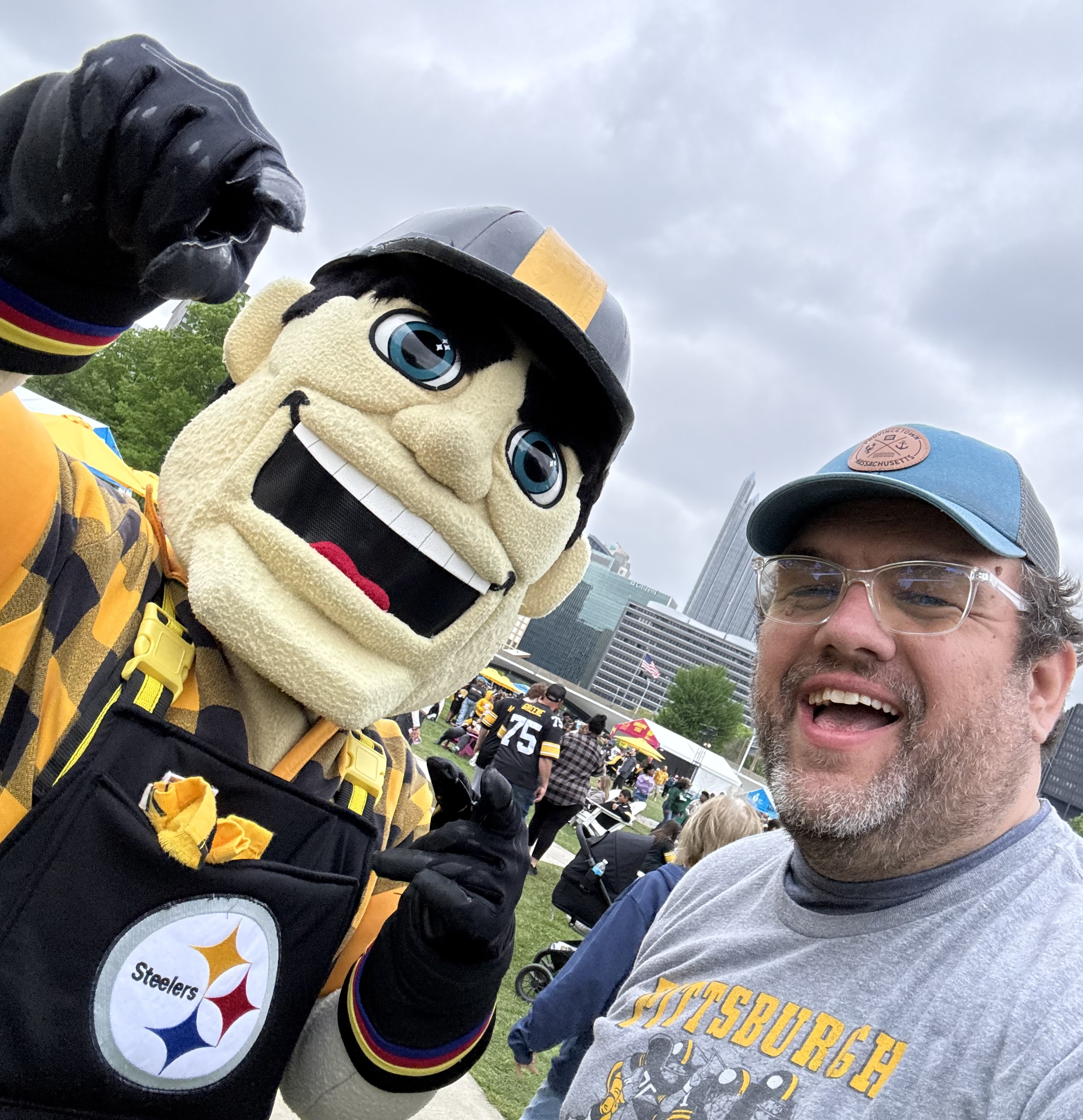
Steely McBeam

Downtown and the North Shore were packed with things to see and do. There were displays, fan experiences, photo opportunities (managed to get a selfie with Steely McBeam!) and plenty of reasons to stop every few feet and look around. The giant Terrible Towel display was a highlight. So were the Lombardi trophies, because let’s be honest, Pittsburgh knows a thing or six about those.

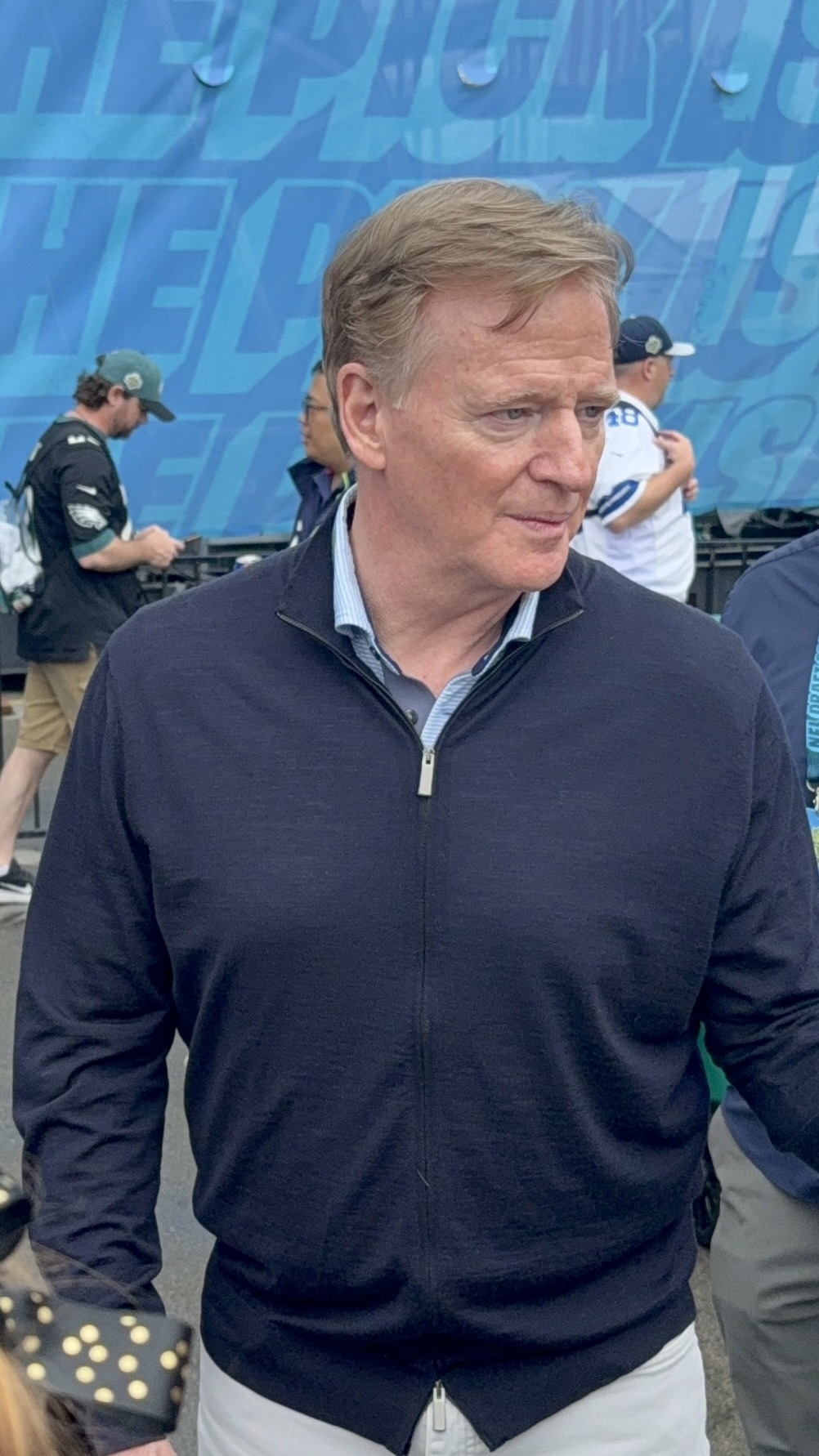
I also spotted NFL Commissioner Roger Goodell and saw plenty of well-known Pittsburghers throughout the weekend.

Roger Goodell
NFL commissioner

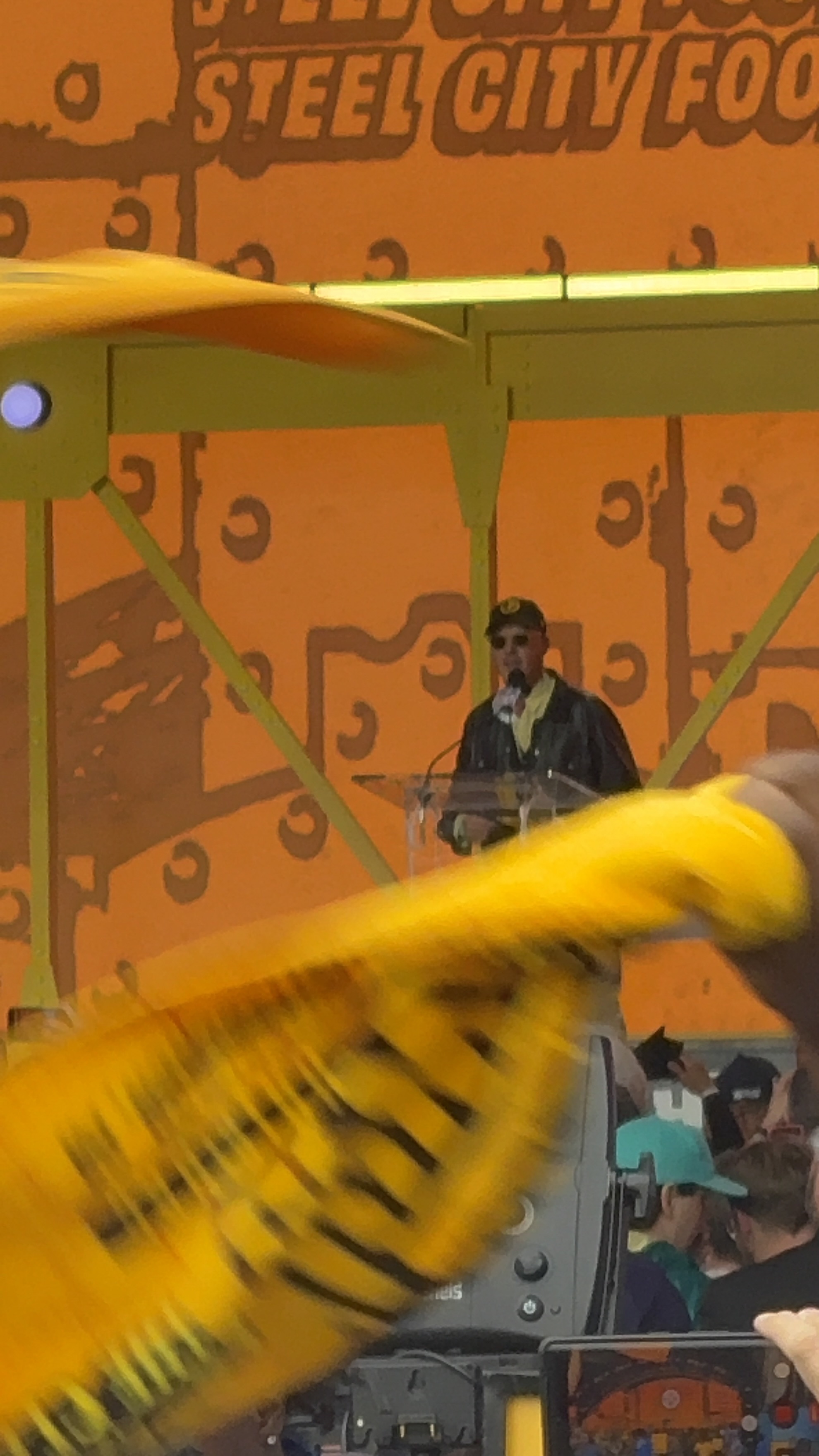
One of my favorite moments was watching Montour High School graduate Michael Keaton present a draft pick. (You might know him as Batman.)

Michael Keaton

There were plenty of those moments.

I watched Pat McAfee host a kicking contest at Heinz Field — yes, I still call it Heinz Field — and got walked on the field. For any football fan, that is a pretty cool experience. For someone from Pittsburgh, it hits a little differently. You look around and think of all the games, all the players, all the memories and all the times that stadium has been part of the region’s story. (*hits play on “Renegade”*)

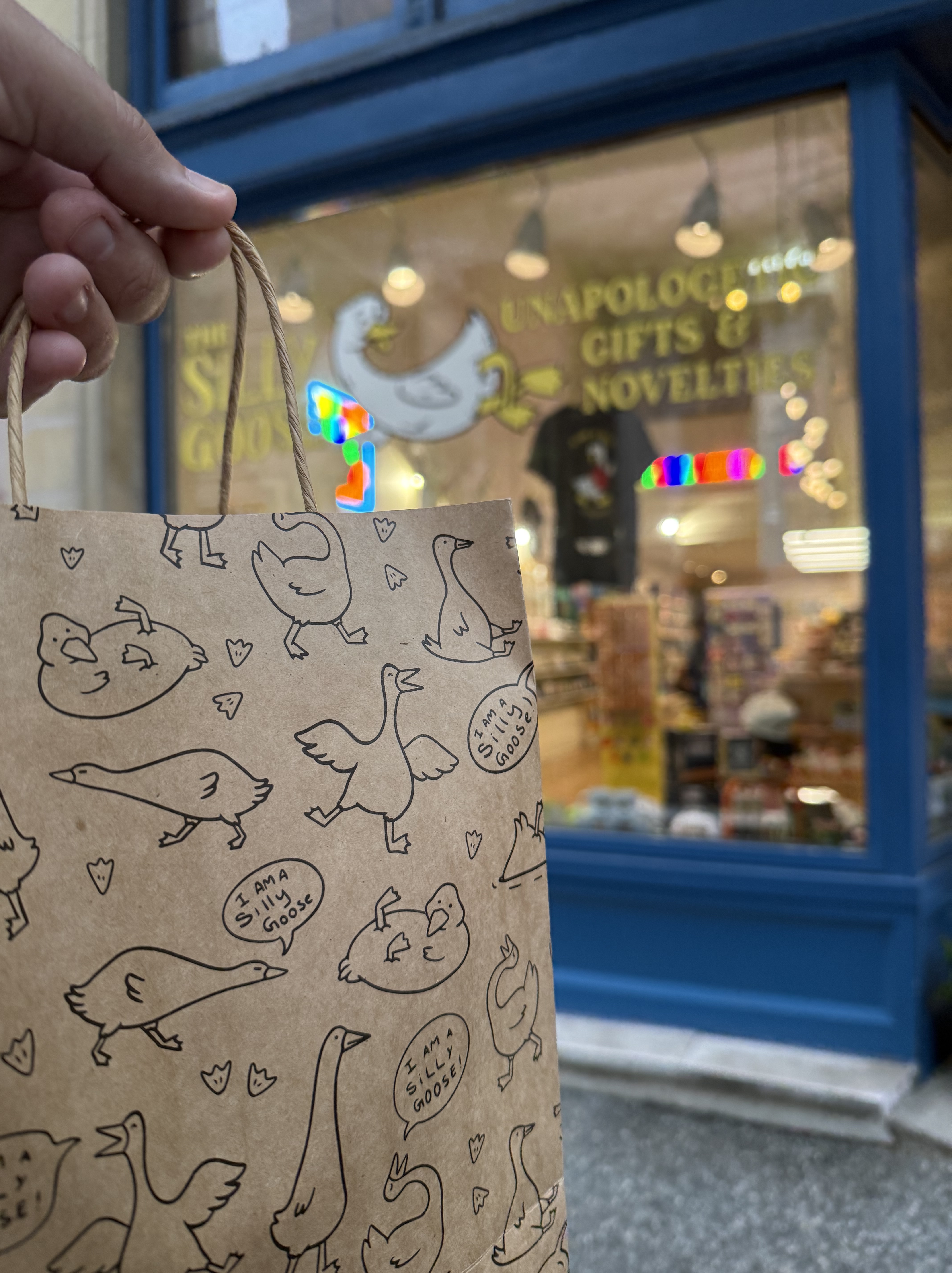
After the draft events, I spent some time walking around Downtown. I stopped into the Silly Goose gift shop, the second location of the store that started in Jim Thorpe, Pa. The owner has become well-known on social media among Pennsylvanians for his dry humor and fun personality, so it was nice to check out the Pittsburgh version in person.

Silly Goose on Wood Street in Pittsburgh

And, because no good Downtown outing is complete without a treat, I got ice cream from Millie’s.

What I loved most was not just the draft itself. It was seeing people experience Pittsburgh.

The NFL Draft gave us a chance to show off a little.

I hope the fans who came here had a great time. I hope they tell people back home that Pittsburgh was worth the trip. And more than anything, I hope they come back.

Because as fun as the draft was, it was only one weekend. There is so much more Pittsburgh waiting for them.

Pittsburgh is on the clock for the NFL Draft, and it’s about time

The NFL Draft coming to Pittsburgh is exciting for a lot of reasons.

There’s the football, of course. There’s the national attention. There’s the chance to welcome fans from across the country to a city that knows a thing or two about the game.

But more than anything, the draft gives Pittsburgh a chance to show people who we are now.

For too long, too many people have held onto an outdated image of Pittsburgh — smoky skies, steel mills and a city stuck in the past. That history matters. It shaped us. It gave this region its grit, its work ethic and its identity.

But Pittsburgh is not a smoggy old mill town waiting to be rediscovered.

We’ve been here all along.

And when the NFL Draft brings visitors, media and football fans to town, they’re going to see a city that is beautiful, lively and full of things to do.

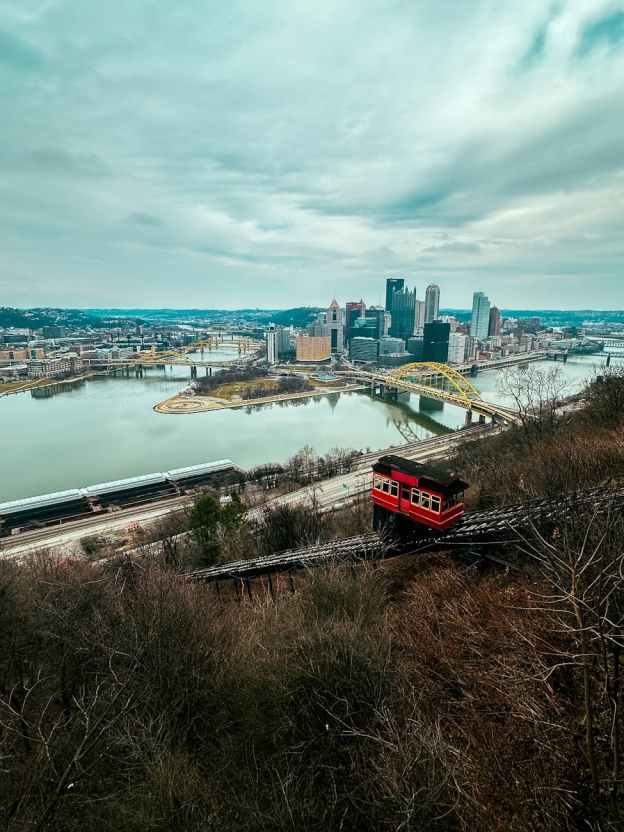
They’ll see our rivers. They’ll see our skyline. They’ll see Downtown, the North Shore, Mount Washington and all sorts of areas that can tell the Pittsburgh story first-hand.

They’ll see a city and region that has changed without forgetting where it came from.

Downtown deserves the spotlight

Pittsburgh’s Downtown is made for a moment like this.

It’s walkable. It’s scenic. It’s packed with history, restaurants, hotels, theaters and riverfront views. You can stand at Point State Park and look out at the place where the Allegheny and Monongahela rivers meet to form the Ohio. You can walk across a bridge to the North Shore. You can look up and see hillsides rising around the city.

That’s not something every city can offer.

And for visitors coming in for the draft, Downtown will be more than a backdrop. It will be part of the experience.

They’ll be able to explore before and after events. They’ll be able to walk to restaurants, museums, bars, theaters and hotels. They’ll be able to see why so many of us love this place—even when we complain about construction, parking or which tunnel is backed up.

Because all of that makes Pittsburgh, Pittsburgh.

We’re more than steel, even if steel helped make us

Pittsburgh should never run away from its steel history or blue-collar mindset.

The mills built communities. They brought families here. They helped create the work ethic people still associate with this region.

But the mistake is thinking the story stopped there.

Today’s Pittsburgh is a city of education, medicine, technology, arts, culture, research, food, sports and neighborhoods with strong identities. It is a place where old industrial buildings have found new life, where riverfronts have become gathering places and where people still feel connected to their communities.

That’s what the NFL Draft can help show.

It can show that Pittsburgh’s past is important, but it is not the only thing that defines us.

Let’s talk about “eds and meds”

People like to use the phrase “eds and meds” when they talk about Pittsburgh’s modern economy.

It can sound a little too simple, but there’s truth behind it.

Our universities, hospitals and research institutions have helped carry this region into a new era. They bring students, doctors, nurses, researchers, professors, patients, families and workers into Pittsburgh from all over the world.

Our museums are worth the trip

Pittsburgh also has museums that deserve national attention.

The Carnegie Museums of Pittsburgh are one of the region’s great cultural assets. Carnegie Museum of Art, Carnegie Museum of Natural History, Kamin Science Center and The Andy Warhol Museum give visitors a little bit of everything — art, science, history, dinosaurs, innovation and one of Pittsburgh’s most famous creative voices.

The Heinz History Center tells the story of Western Pennsylvania in a way that helps people understand how this region grew, changed and contributed to the country.

And Phipps Conservatory and Botanical Gardens is one of the most beautiful places in the city. It is a reminder that Pittsburgh is greener, brighter and more alive than outsiders sometimes expect.

These are places that make Pittsburgh richer. They give families, students, visitors and longtime residents reasons to keep learning and exploring.

Don’t forget the libraries

Pittsburgh is also a library city.

The Carnegie Library of Pittsburgh system is one of the city’s most important civic resources. Its branches serve neighborhoods across the city and offer far more than books. They offer programming, public space, internet access, job resources, children’s activities and a place for people to gather.

Across the county, the Allegheny County Library Association and the network of suburban libraries do the same kind of work.

Libraries are one of the best measures of a community’s priorities. In Pittsburgh and Allegheny County, they remain vital pieces of public life.

When visitors come here, they may notice the stadiums first. That’s fine. They’re hard to miss.

But part of what makes Pittsburgh special is that our pride extends beyond sports. It includes the places that help people read, learn, connect and grow.

The arts are part of the city’s heartbeat

Let’s not forget about Pittsburgh’s arts scene.

The Cultural District has helped make Downtown a destination for theater, music, dance and public art. The Pittsburgh Cultural Trust has been a major part of that transformation.

Pittsburgh CLO brings musical theater to generations of audiences. Heinz Hall remains one of Downtown’s great landmarks and the home of the Pittsburgh Symphony Orchestra. The Benedum Center, Byham Theater and other venues help keep the city’s arts scene active year-round.

This is another part of Pittsburgh that surprises people.

They come expecting sports. They find theater, music, dance, galleries, festivals and public art.

That combination is what makes the city interesting. You can go from a football game on the North Shore to a show Downtown in the same night. You can spend one day at a museum and the next at Kennywood.

There’s plenty of fun here, too

Speaking of Kennywood, the isn’t limited to Downtown and the city’s limits.

Kennywood is one of the great Pittsburgh traditions. Generations of families have gone there for roller coasters, Potato Patch fries and summer nights that feel like childhood.

Just down the road from Kennywood, its water park, Sandcastle, gives the region a place to cool off along the Monongahela River. (Not in, though — let’s make that distinction, haha.)

And about an hour away from Kennywood is sister park Idlewild, which is part of the Western Pennsylvania family tradition, especially for younger kids and parents who want a day that feels a little slower and a little sweeter. Daniel Tiger and his friends are among the main attractions at Idlewild.

This is Pittsburgh’s moment

The NFL Draft will bring attention to Pittsburgh.

That is good for the city. It is good for restaurants, hotels, small businesses and attractions. It is good for the people who have been saying for years that Pittsburgh deserves more credit than it gets.

But the most exciting part is not just that people will come here, it is that they will see a city with three rivers, great neighborhoods, strong institutions, beautiful parks, serious culture and a sense of identity that cannot be — dare I say — manufactured.

They will see that Pittsburgh is not stuck in the past.

They will see that we are proud of where we came from and excited about where we are going.

And maybe, after a few days here, they’ll understand what we already know: Pittsburgh is a great place to visit, a great place to explore and a great place to call home.
You should care more about the Nexstar/Tegna merger than you do

You should care more about the Nexstar/Tegna merger than you do because it will have an impact on you — and it won’t be good.

A friend who still works in news texted me this morning after the Nexstar/Tegna merger news: “You got out at the right time.”

I had already been talking with two other friends about the merger — one who works in news and one who also got out — when she messaged that.

Her words really struck me. Leaving journalism is something I wrestle with far too often.

I miss following stories that actually affected people’s lives — directly and indirectly, and in ways they did not even realize.

I miss knowing more than the average person about what was happening in local government, in schools, in neighborhoods, on roads people drive every day.

I miss asking elected officials very basic questions and watching them get annoyed that someone was paying attention.

I miss all of what news was.

I left full-time journalism at the end of 2022.

At the time, I was working for a television news company, but none of this happened overnight. I had seen the shift starting years earlier — even a decade earlier — as people became more hostile toward local news and as newsrooms slowly started prioritizing things other than the news itself. For me, 2020 felt like a tipping point. That is when everything already in motion seemed to move into overdrive.

Important news was still getting covered. Real journalism was still happening.

But as attention spans waned and eyeballs wandered to other forms of media (like TikTok, Instagram, YouTube), the draw to make headlines more sensational, videos shorter with less information and more gimmicks only intensified.

And it was not just happening in TV. It was happening everywhere.

There appeared to be less emphasis on actually informing people and more emphasis on feeding the machine.

More and more news outlets were referring to news as “content.” And that “content” included links to Amazon products, useless user-submitted photo galleries, rewritten news releases and archived video made to look like something new.

And, I need to note, good journalism is still out there. People are still fighting to do quality journalism every day.

But too much of it is buried under junk, largely driven by the powers that be (typically, people who just have money to buy a news outlet or a few and have no actual concern about the news — or people being driven by those demands).

Maybe my friend is right. Maybe I did get out at the right time.

But I still go back and forth. Some days, I feel like I let news down by leaving. Other days, I know I was protecting myself by stepping away from a fight that already felt lost.

Defying gravity or dragging along? My take on the ‘Wicked’ movie

Seeing the “Wicked” movie on a “pre-screening” night marked a significant step in my ongoing quest to understand this beloved story.

As someone who treasures “The Wizard of Oz,” I’ve always struggled with the narrative of “Wicked.”

While I’ve never seen the stage show live, I’ve read the book and watched a couple of bootleg videos of the Broadway production.

Each time, I found myself lost in the sprawling first act, overwhelmed by how much “Wicked” tries to pack into its story.

The movie helped bring some clarity.

Finally, I could better grasp the narrative threads tying Elphaba’s and Glinda’s journeys together.

The film’s visual grandeur and talented cast certainly helped.

Cynthia Erivo’s Elphaba is magnificent, capturing both vulnerability and power, while Jonathan Bailey’s Fiyero shines with charm and intrigue.

Ariana Grande, as Glinda, perfectly embodies the character’s bubbly exterior and hidden depth.

Adding to the film’s nostalgic appeal, original Broadway stars Idina Menzel and Kristin Chenoweth make brief appearances in the movie.

While their roles are small, their presence is a touching nod to fans of the stage show who have cherished their iconic portrayals of Elphaba and Glinda.

Seeing them included felt like a heartfelt acknowledgment of the legacy they created and a passing of the torch of sorts to Erivo and Grande, who now carry the story forward for a new generation of “Wicked” enthusiasts.

Despite its strengths, the movie’s pacing remains an issue.

At 2 hours and 40 minutes, “Wicked: Part One” (which is what this should be called in marketing efforts of the film) is longer than the entire Broadway production (2 hours and 30 minutes not counting the intermission), yet it tells only half the story.

This choice feels excessive, as the first part of the film drags in places, making me question why the story needed to be split into two movies.

One aspect where the movie excels is capturing the emotional core of “Wicked.”

At its heart, the story explores themes of friendship, identity and finding one’s voice in a world that silences those who are different.

This resonates deeply in today’s society, where marginalized groups often fight to be heard and valued.

The plight of the animals in “Wicked”—stripped of their ability to speak and ostracized by society—mirrors the experiences of those who face systemic oppression.

The story challenges viewers to question their complicity and consider the changes needed to create a more equitable world, especially for those whose struggles are too often ignored by the privileged.

That said, my longstanding issues with “Wicked” remain.

While many view it as enriching and expanding “The Wizard of Oz,” I’ve always felt it tries to undo the original’s magic.

The backstory for iconic characters like the Tin Man and Scarecrow feels forced, as though it diminishes the wonder of “The Wizard of Oz” rather than complementing it.

Ultimately, my journey with “Wicked” continues.

The movie offered a deeper understanding of the story but didn’t fully resolve my ambivalence.

Perhaps “Wicked: Part Two” will hold the answers—or perhaps “Wicked” is simply a story I’ll always admire from a distance, even if it doesn’t fully click for me.

Finding strength in vulnerability and connection

World Mental Health Day is observed on Oct. 10, serving as a reminder of the importance of mental health awareness and the necessity of seeking help for mental health issues. Addressing these challenges can lead to improved well-being, enhanced coping strategies and a better quality of life for everyone.

Acknowledging our mental health struggles is a crucial step in fostering well-being. It’s all too easy to downplay our emotions, convincing ourselves that “someone else has it worse” or that our struggles are insignificant. However, doing so invalidates our own feelings and experiences. Pain is personal; just because others may be going through difficult times doesn’t make what we experience any less real or worthy of attention. We all deserve to feel what we feel, and recognizing that our emotions are valid is essential to our healing process.

Surrounding ourselves with people who genuinely show up for us during these difficult moments is equally important. Genuine friends and loved ones provide the support system we need when things feel overwhelming. They offer understanding, compassion and a much-needed listening ear. These are the people who remind us that we’re not alone, who don’t just offer words of comfort but stand by us when we need it most. Relationships like these can act as a lifeline when we’re struggling, allowing us to feel seen, supported and cared for.

In addition to seeking support from friends and others, pursuing medical help or counseling is a healthy and brave way to address mental health challenges. Therapy or medical guidance can provide the tools, strategies and perspectives needed to manage our mental health effectively. It creates the space for us to process our emotions in a constructive way, enabling us to develop coping mechanisms that work for us. Seeking help is not a sign of weakness; rather, it’s a powerful step toward healing and growth.

We all experience hard times, and while it’s perfectly OK to not feel OK, what’s most important is that we give ourselves permission to seek help, to be vulnerable, and to acknowledge our feelings without dismissing them. Recognizing that we deserve care — whether through friendship, therapy, or a combination of both — is vital. Our mental health matters, and prioritizing it can lead us toward a more fulfilling life.

On this World Mental Health Day, and every day, let’s take a moment to:

  • Reflect on our mental health
  • Reach out to someone who may need support
  • Remind ourselves that we are not alone in our struggles

Whether you seek help through professional resources, open conversations with friends, or simply taking time for self-care, remember that every step taken toward addressing mental health is a step toward a brighter, healthier future. Let’s commit to breaking the stigma surrounding mental health and encourage open dialogues that foster understanding, compassion, and support for one another.