Category Archives: pittsburgh

Remembering Joe Negri, and the afternoon I interviewed a childhood icon

Joe Negri, the jazz guitar virtuoso beloved by generations as Handyman Negri on “Mister Rogers’ Neighborhood,” died May 30, just days shy of his 100th birthday. He was 99.

For many, Negri was part of the fabric of childhood television — a kind, steady presence in the Neighborhood of Make-Believe who could sing, play guitar and offer a little help when help was needed.

On the show, he appeared as Handyman Negri and as the owner of Negri’s Music Shop, a fitting role for a real-life Pittsburgh musician. Fred Rogers Productions describes him as a jazz guitarist and “friendly neighbor” whose music shop helped introduce a wide variety of musical guests to the show.

But in Pittsburgh, Negri was more than a familiar face from television. He was a musical institution — a gifted guitarist, teacher and performer whose career stretched across decades.

I knew all of that when I met him in 2017.

Still, none of it prepared me for what it felt like to sit across from Handyman Negri.

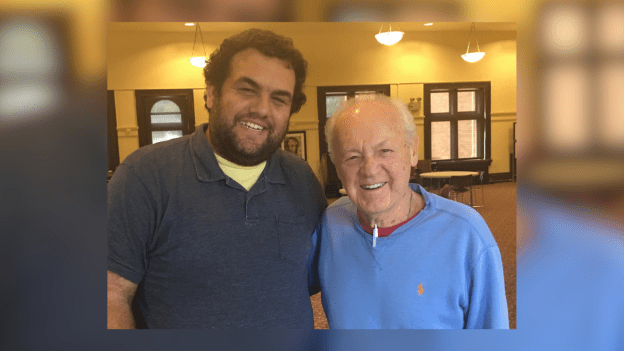
At the time, I was editor of The Signal Item in Carnegie. Negri was scheduled to perform at the Andrew Carnegie Free Library & Music Hall, and the library’s then-director, Maggie Forbes, arranged for me to interview him at the library.

Some interviews stick with you long after the story is published.

Meeting Joe Negri in 2017 was one of those moments.

It remains one of the top memories of my time at the Tribune-Review and of my career as a journalist.

He was, after all, a childhood icon.

For anyone who grew up watching “Mister Rogers’ Neighborhood,” the people who appeared on that show were not simply performers. They helped build a world where children were spoken to gently, taken seriously and reminded that they mattered.

Our interview went much longer than either of us had expected. At one point, Maggie came to check on us, likely wondering how a simple interview had stretched into something closer to a visit between old neighbors.

Negri was sharing stories about working on the show and, of course, about Fred Rogers.

“They brought Fred over to WTAE where I was the musical director,” Negri told me in 2017. “He was going to start a ‘Mister Rogers’ Neighborhood’ for 15 minutes. It was a prototype of what the show became. He opened it up at the piano. Then he went via the trolley into the neighborhood. The station put me on the show to assist with the music.”

Negri said he already knew Rogers a bit from the early days of WQED.

“He worked with Josie Carey, who was a good friend of mine,” Negri said of Carey, who was a well-known host of children’s television shows. “We worked together very well.”

What began as a music role slowly became something more.

“Little by little, he would say to me, ‘Why don’t you walk around the neighborhood and talk to the puppets,’” Negri said. “That’s what Josie used to do in the old ‘Children’s Corner.’ So I would walk around and talk to King Friday and X the Owl, Lady Elaine Fairchilde. It was fun. He and I hit it off and the show was good.”

But Rogers, Negri recalled, resisted pressure to turn the show into something commercial.

“The sales department wanted him to sell products. And he didn’t like the products,” Negri said. “He wouldn’t sell GI Joe. He wouldn’t sell food he didn’t believe in, like cereal with sugar. So he fought with the sales department, and within six months he was out of there.”

A year later, Rogers called him.

“He said, ‘Would you like to be the handyman?’” Negri recalled. “I said, ‘I think you’re kidding. You’re picking the wrong guy.’ I wasn’t a good actor, and I wasn’t a handyman.”

He laughed when he told that story.

“It worked out alright,” he said.

It certainly did.

Negri remembered the guests, too.

“We had some wonderful guests,” he told me in 2017. “I remember the Wicked Witch of the West from ‘Oz,’ Big Bird.”

Sitting there with him, I was struck not only by the history he carried but by how graciously he carried it. He was generous with his time, generous with his stories and generous with the emotions people brought to him because of the show.

At one point, I told him how much “Mister Rogers’ Neighborhood” meant to me. Then I apologized, saying I was sure he heard that all the time.

His response has stayed with me ever since.

He told me he loved when people shared their memories with him. To him, it meant the show had done its job. It meant people had been moved by it.

That simple answer captured so much of what made Negri, Rogers and that neighborhood so special. They understood that public broadcasting and children’s television could do something lasting.

When the interview ended, I walked back to my car and cried.

Not out of sadness, exactly. It was gratitude, nostalgia and the overwhelming feeling of having met someone who had once seemed to live only inside the television set. It was the emotion of sitting with a person connected to something that had helped shape me, then realizing the kindness I remembered from childhood was real.
Pittsburgh showed up for the NFL Draft — and so did everyone else

Pittsburgh had its moment on the national football stage, and the region delivered.

I spent most of Friday and Saturday in Downtown Pittsburgh and on the North Shore, taking in the NFL Draft events, walking around, talking with visitors and soaking up a weekend that felt equal parts football festival and Pittsburgh pride.

It was a blast.

I started both days in Moon, parking at the park-and-ride lot and taking Pittsburgh Regional Transit’s Football Flyer into town. It was quick and easy. As a public transit fan, it was a great way to invite suburbanites and people who don’t think about public transit to experience a big event and skip the traffic, letting someone else handle the drive.

The bus rides became part of the experience. I met people from Ohio, Illinois, California, Washington state and New England. Some were staying in hotels around Moon, Robinson and the airport area. Others had driven in from Ohio for the day. There were Browns fans, Chargers fans, Bengals fans, Ravens fans (ugh) and, yes, even Eagles fans (boo!).

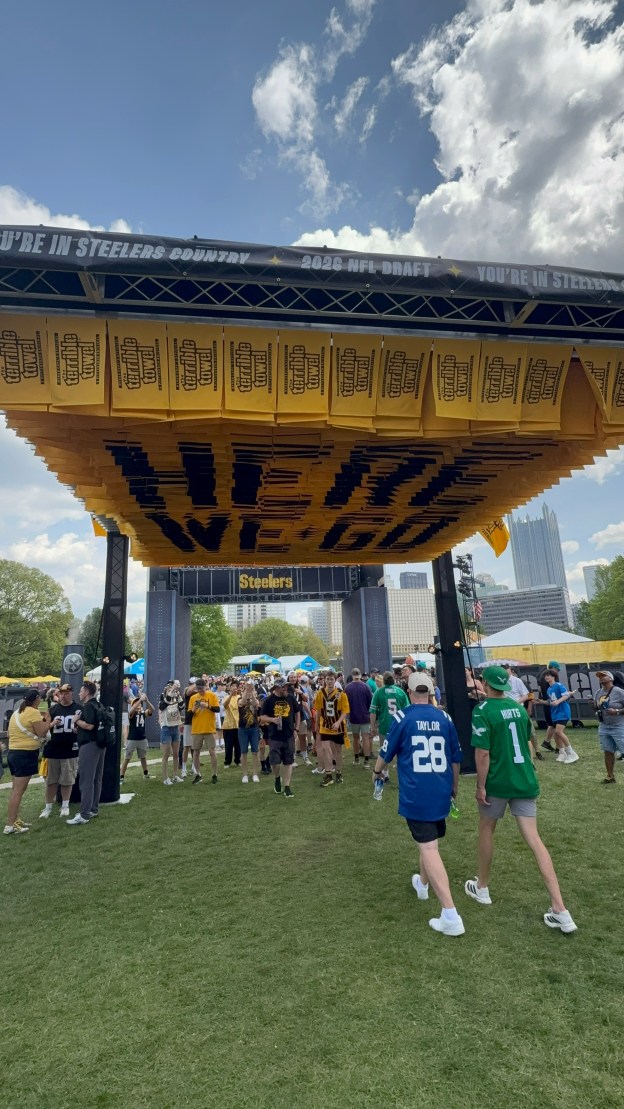
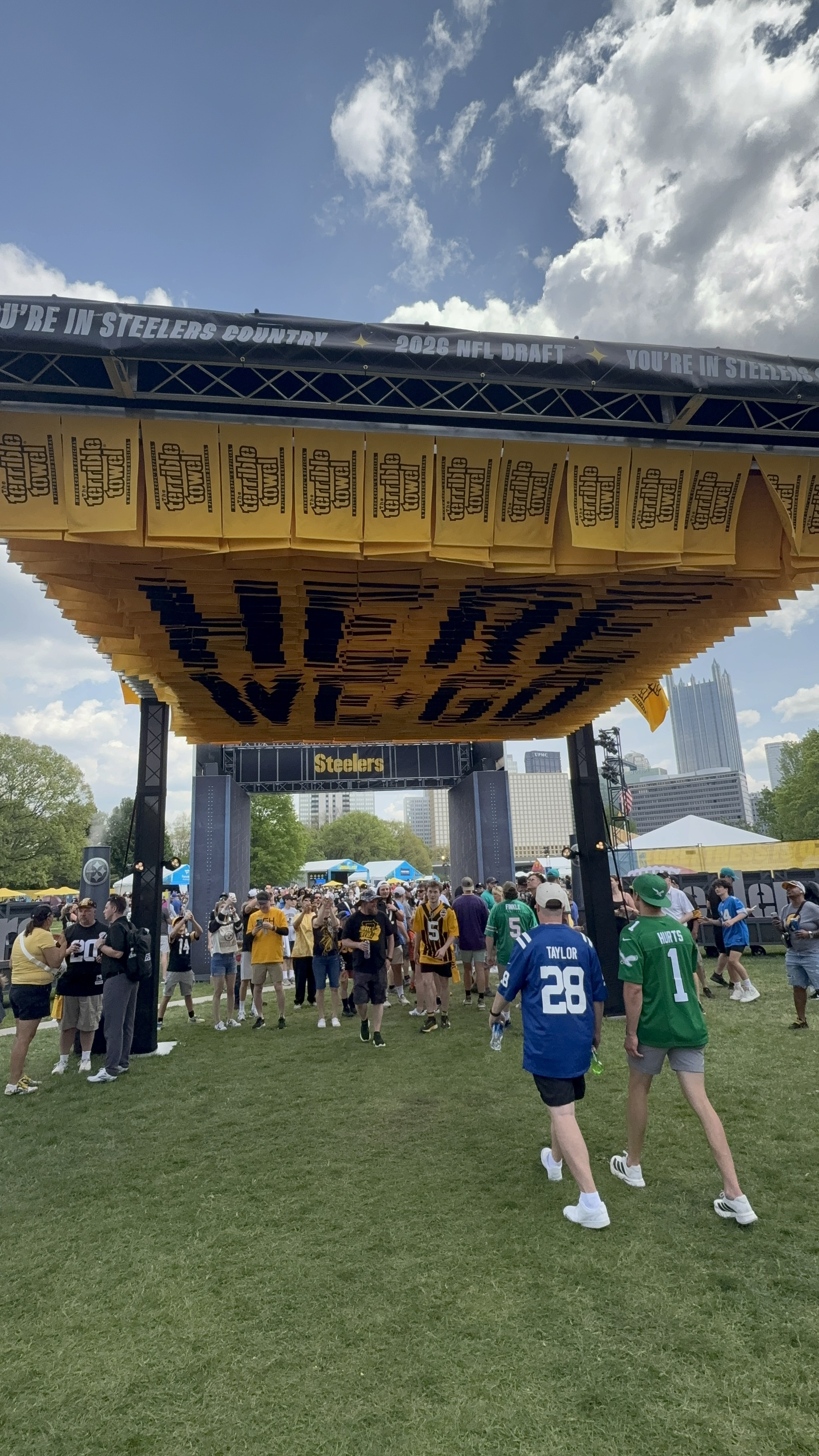
Terrible Towel display

That was one of the best parts of the weekend: Seeing so many different fan bases walking around Pittsburgh. Team jerseys, hats and shirts were everywhere — on the bus, Downtown, along the North Shore and even at the Sheetz in Moon. There is something funny and wonderful about walking into a Sheetz and seeing a mix of Steelers, Browns, Ravens, Vikings, Cowboys and Bengals gear all in one place.

That does not happen every day.

Steely McBeam

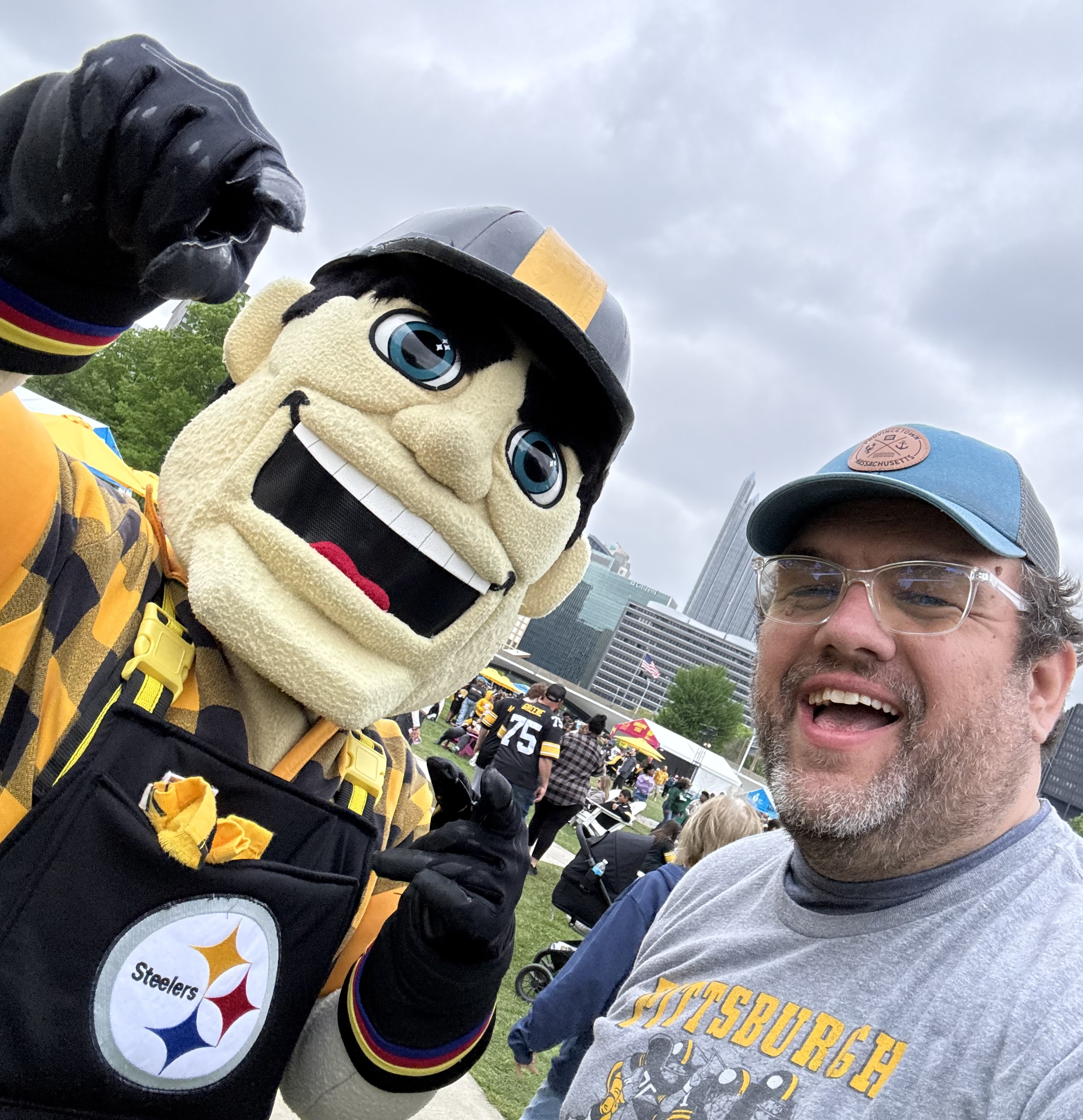
Downtown and the North Shore were packed with things to see and do. There were displays, fan experiences, photo opportunities (managed to get a selfie with Steely McBeam!) and plenty of reasons to stop every few feet and look around. The giant Terrible Towel display was a highlight. So were the Lombardi trophies, because let’s be honest, Pittsburgh knows a thing or six about those.

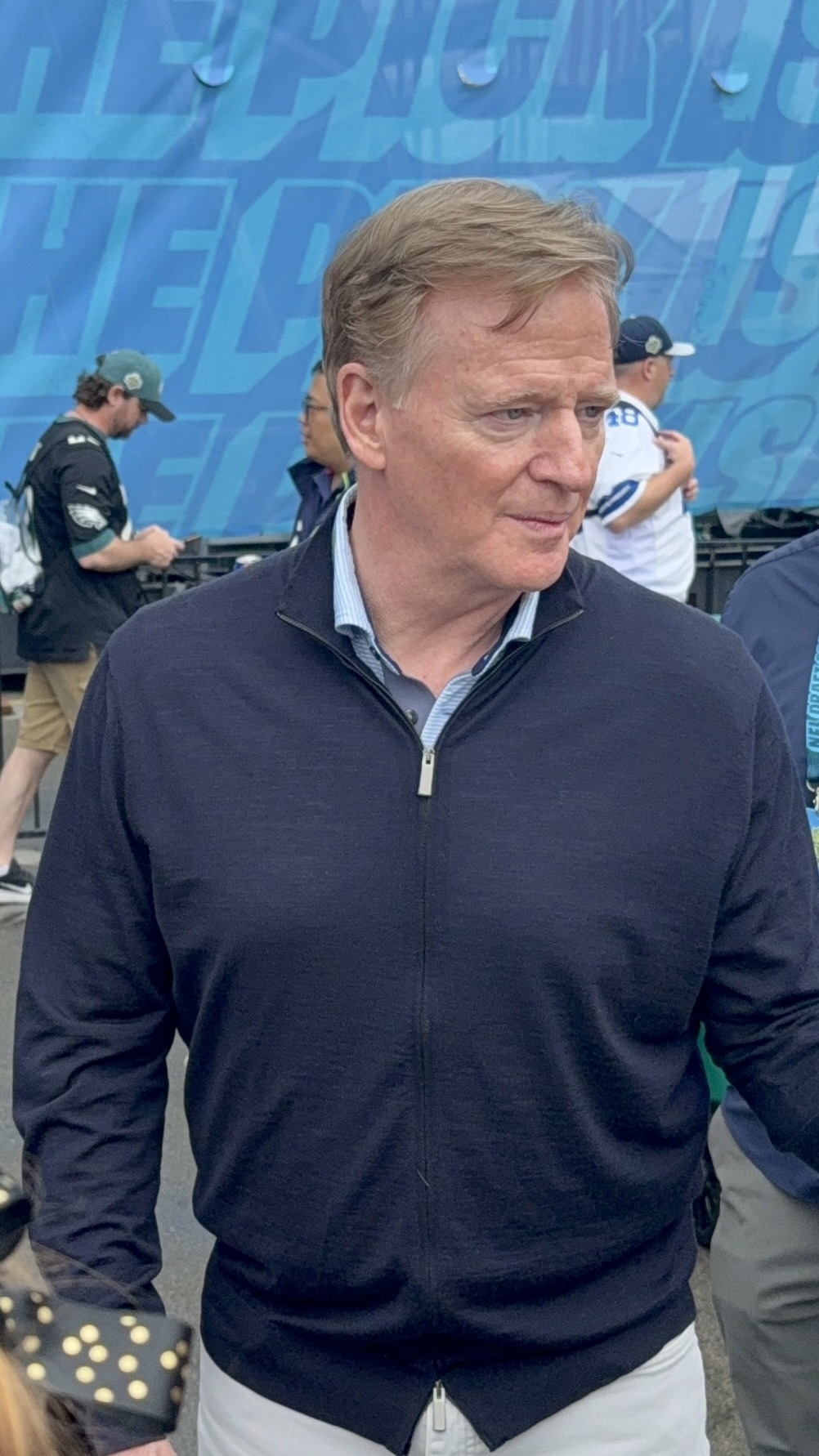
I also spotted NFL Commissioner Roger Goodell and saw plenty of well-known Pittsburghers throughout the weekend.

Roger Goodell
NFL commissioner

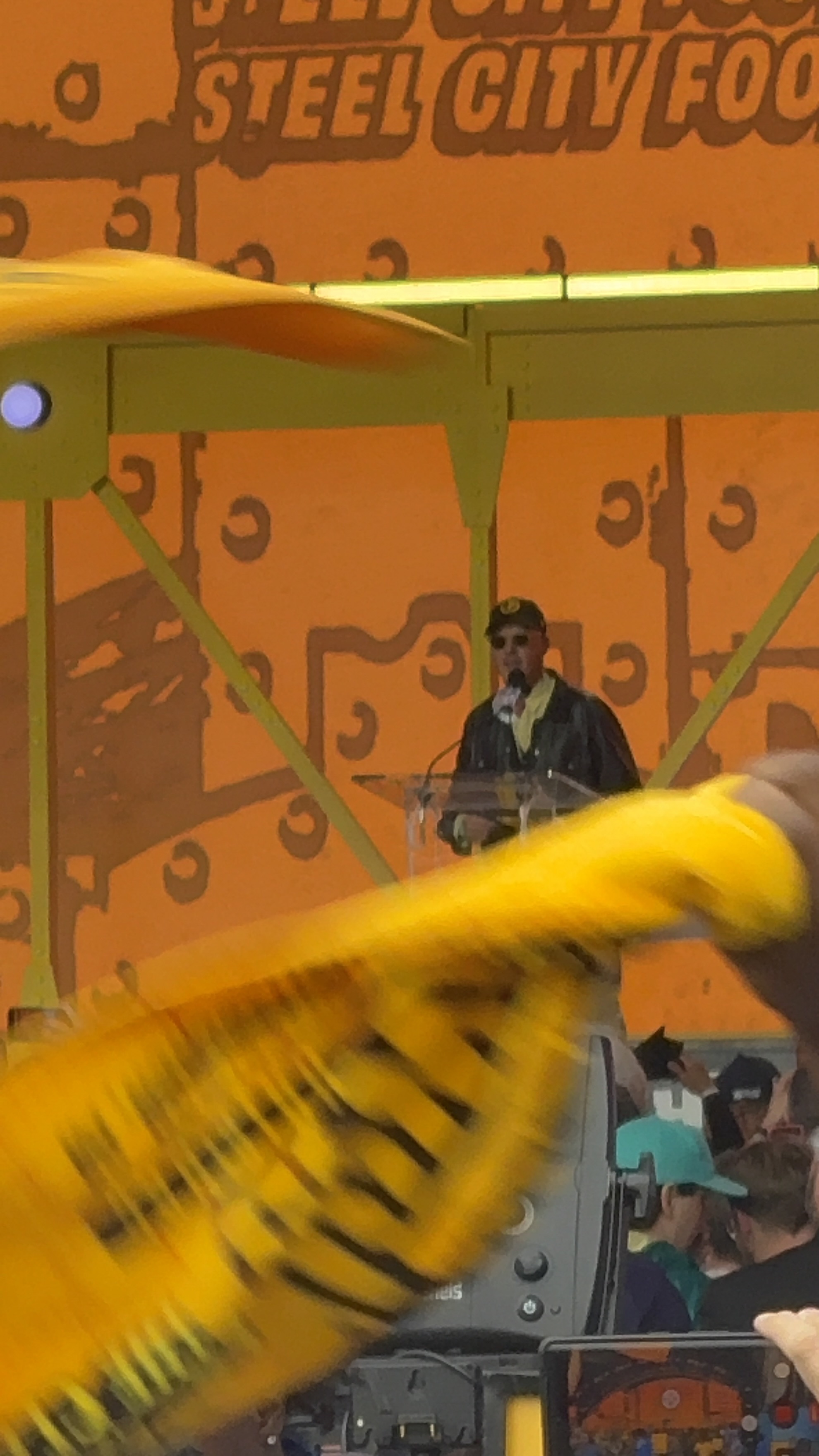
One of my favorite moments was watching Montour High School graduate Michael Keaton present a draft pick. (You might know him as Batman.)

Michael Keaton

There were plenty of those moments.

I watched Pat McAfee host a kicking contest at Heinz Field — yes, I still call it Heinz Field — and got walked on the field. For any football fan, that is a pretty cool experience. For someone from Pittsburgh, it hits a little differently. You look around and think of all the games, all the players, all the memories and all the times that stadium has been part of the region’s story. (*hits play on “Renegade”*)

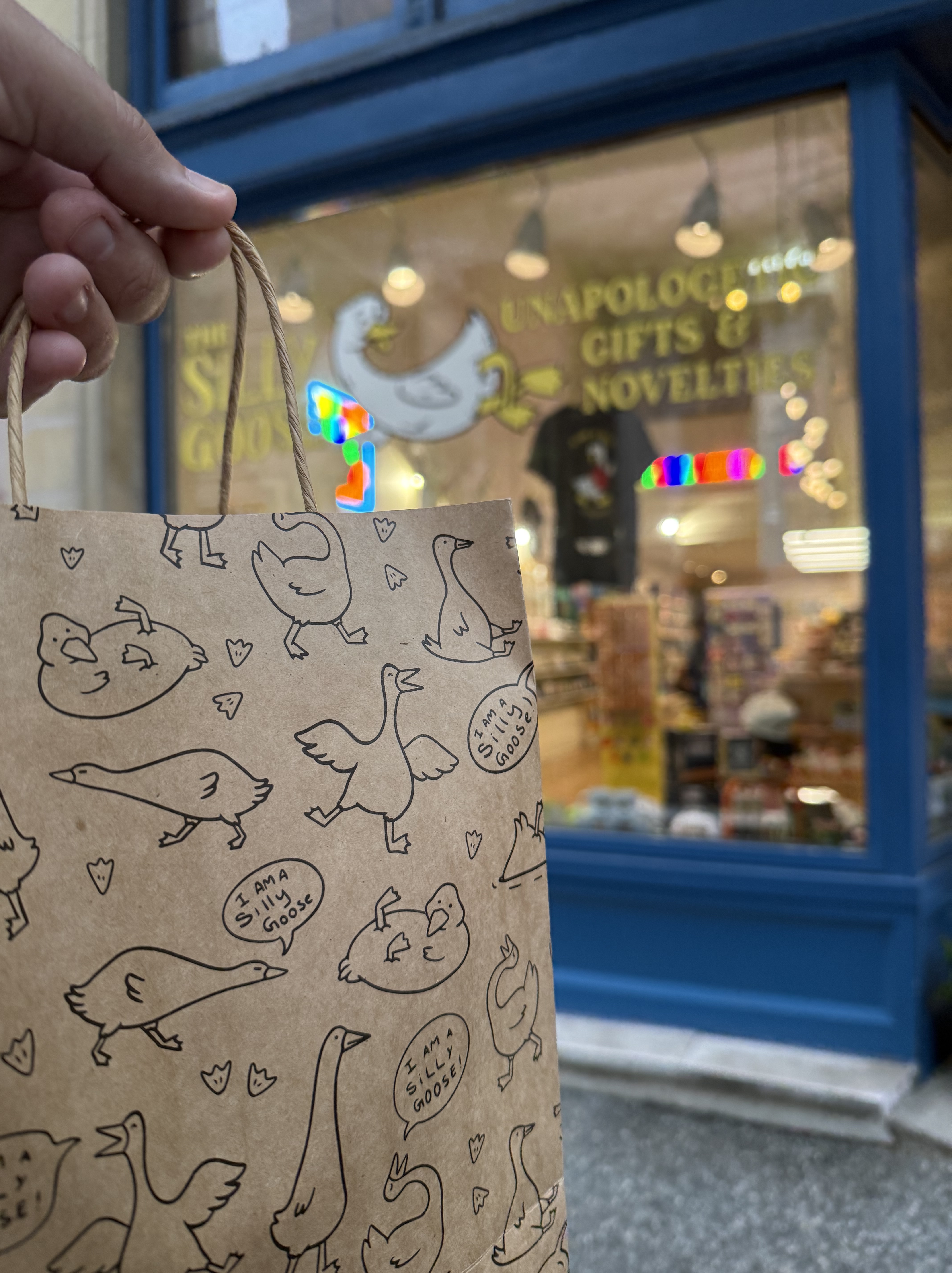
After the draft events, I spent some time walking around Downtown. I stopped into the Silly Goose gift shop, the second location of the store that started in Jim Thorpe, Pa. The owner has become well-known on social media among Pennsylvanians for his dry humor and fun personality, so it was nice to check out the Pittsburgh version in person.

Silly Goose on Wood Street in Pittsburgh

And, because no good Downtown outing is complete without a treat, I got ice cream from Millie’s.

What I loved most was not just the draft itself. It was seeing people experience Pittsburgh.

The NFL Draft gave us a chance to show off a little.

I hope the fans who came here had a great time. I hope they tell people back home that Pittsburgh was worth the trip. And more than anything, I hope they come back.

Because as fun as the draft was, it was only one weekend. There is so much more Pittsburgh waiting for them.

What is Pittsburgh without the Post-Gazette?

Like sands through the hourglass… the drama around the impending death of the Pittsburgh Post-Gazette just keeps getting more convoluted.

On Jan. 7, Block Communications dropped a bomb on the region: The Pittsburgh Post-Gazette — a newspaper that’s been part of this community’s civic fabric for nearly 240 years — will publish its final edition May 3, and the entire operation will cease to exist.

This isn’t just another checkmark in the long casualty list of American journalism. This is the newspaper that defined reporting in Pittsburgh, that held power accountable and that offered depth few outlets even attempt anymore.

And soon, it will be gone.

How did the PG get here?

In July 2020, the Post-Gazette declared an impasse in contract negotiations with the Newspaper Guild of Pittsburgh and unilaterally altered employees’ terms of employment, including health care. (Federal labor authorities later ruled those actions violated labor law.)

That decision sparked a newsroom strike on Oct. 18, 2022, that stretched on for more than three years, officially ending Nov. 13, 2025. PG journalists had been without a contract since 2017.

More recently, a federal appeals court upheld a ruling requiring the company to honor its labor obligations. Block Communications sought a stay from the U.S. Supreme Court. When the justices refused to grant it, the company chose closure over compliance.

The scramble to save something — anything

Since the Blocks refused to comply with the ruling, local groups and individuals have announced a flurry of plans — to expand coverage, remind readers they exist, build something new or attempt to acquire PG assets to keep something alive.

Nearly 50 newsroom staffers who did not strike have called for new union elections and proposed either saving the paper or starting a new one.

Those 49 staffers appear ready to bend the knee. “In today’s media landscape, we must be realistic, not idealistic,” they wrote collectively, adding that they want to “change the tone of our union’s relationship with the Post-Gazette.” Because that has ever worked well for unions.

In a separate effort, former Penguins executive Kevin Acklin is attempting to line up investors to convert the Post-Gazette into a nonprofit newsroom. In an interview with Axios Pittsburgh, Acklin said he had a “good opening conversation” with Allan Block, CEO of Block Communications.

“We feel strongly that converting to a nonprofit is a very attractive alternative to shutting down the Post-Gazette,” Acklin said. “I am hopeful the present ownership group recognizes the importance of the paper to the ongoing vitality of our city.”

His full letter to Block was published in a WESA story.

Meanwhile, the Newspaper Guild of Pittsburgh has launched its own initiative — Pittsburgh Alliance for People-Empowered Reporting, or PAPER — aimed at carrying forward the spirit of PG journalism outside Block ownership. The union recently held a virtual meeting that it says drew 145 attendees, despite technical hiccups.

“You made it very clear that you’re eager for an alternative to the Block-owned PG — for something that authentically connects our communities and better reflects the concerns of working-class people,” the guild wrote in a follow-up message. The group plans a public launch in the coming days.

And if all of that weren’t enough, the Tribune-Review announced it will launch a weekend “Pittsburgh” print edition starting May 9. A weekly printed summary of news is not a daily newsroom embedded in the region it serves. Trib staffers are already stretched thin covering Westmoreland County, the Alle-Kiski Valley and whatever drives clicks online.

(Also: why this wasn’t launched before the PG’s closure is anyone’s guess — and speaks volumes.)

A fractured news ecosystem

Pittsburgh won’t technically become a “news desert” when the Post-Gazette closes. There are other news outlets — and operations masquerading as news outlets — that all provide some level of journalism or information sharing.

Public Source. Next Pittsburgh. Pittsburgh Magazine. CityCast Pittsburgh. Pittsburgh Jewish Chronicle. Pittsburgh Business Times. Axios Pittsburgh. Plus television and radio: KDKA-TV, WTAE, WPXI, WESA and KDKA Radio.

None of them offers the depth, breadth or daily accountability journalism the Post-Gazette once provided. Some, in fact, often rely on the PG for their own reporting.

That fragmentation has been happening for years as the paper downsized following circulation cuts, ad revenue losses and Block dysfunction: Suburban weeklies reduced to ad circulars, websites with little original reporting, influencer feeds posing as news, PR firms pushing spin, communications teams rebranded as “content creators.”

You already have to work to find real reporting on Pittsburgh and Allegheny County. Removing the Post-Gazette doesn’t simplify the ecosystem — it makes it harder.

The PG’s decline also mirrors a national trend. Locally, the region has lost countless newspapers that once covered suburban communities, school boards and borough councils. With those losses went community calendars, nonprofit announcements and everyday civic information.

People used to look in one place to understand what was happening around them. Now they must subscribe to a patchwork of newsletters, Facebook groups and alerts — and still get less news.

Newspapers helped build community

“The local newspaper not only informs citizens but also helps build community among its readers,” Andrew Conte wrote in his 2022 book, “Death of the Daily News: How Citizen Gatekeepers Can Save Local Journalism,” which examined the closure of the McKeesport Daily News.

Conte references political scientist Robert Putnam’s “Bowling Alone: The Collapse and Revival of American Community,” which argues that social capital — networks of trust and civic participation — has been eroding for decades. Putnam also found a link between newspaper readership and civic engagement.

Without newspapers, it becomes harder for people to share information, build trust and participate meaningfully in public life.

The trance we didn’t notice

Conte also cites media theorist Marshall McLuhan, who warned about society’s failure to recognize how new media reshape behavior.

“If we continue in our self-induced subliminal trance, we will be their slaves,” McLuhan said, referring to electronic media of the time — notably, television.

He died in 1980, three years before the internet.

Apply that logic to cable TV, video games, computers, smartphones, streaming, social media — and now AI. There may never have been a moment more hostile to shared facts and verified information than now.

A less informed public and fractured communities create fertile ground for misinformation, distrust and apathy. Chaos.

This isn’t nostalgia

I love news. I love newsrooms.

But this isn’t nostalgia. It’s a sober assessment from someone who’s worked in journalism and understands what quality reporting actually looks like — as both a journalist and a reader.

Pittsburgh’s civic discourse — what we know, what we debate, who we hold accountable — is poorer without its paper of record. In May, we’re going to find out just how much poorer.

The Science Behind Pixar: A journey into animation at Carnegie Science Center

If you’ve ever wondered how Pixar creates its iconic animated films, the answers await you at “The Science Behind Pixar,” an immersive exhibit at the Carnegie Science Center.

After experiencing this immersive, hands-on journey myself, I can confidently say this exhibit is a must-see for fans of animation, science and storytelling alike.

Opened in May 2024 and extended through Jan. 26, the two-story, 12,000-square-foot exhibition transforms the PPG Science Pavilion into “PIXARburgh,” drawing visitors of all ages to dive into the fascinating intersection of science, technology, engineering and math (STEM) that fuels Pixar’s creative magic.

A behind-the-scenes look at Pixar’s movie-making process

From the moment you step into “The Science Behind Pixar,” you’re invited to explore the complex world of animation.

The exhibit features more than 50 hands-on activities that break down the intricate steps Pixar takes to bring beloved films like “Toy Story,” “Monsters Inc.” and “Finding Nemo” to life.

At various interactive stations, you can:

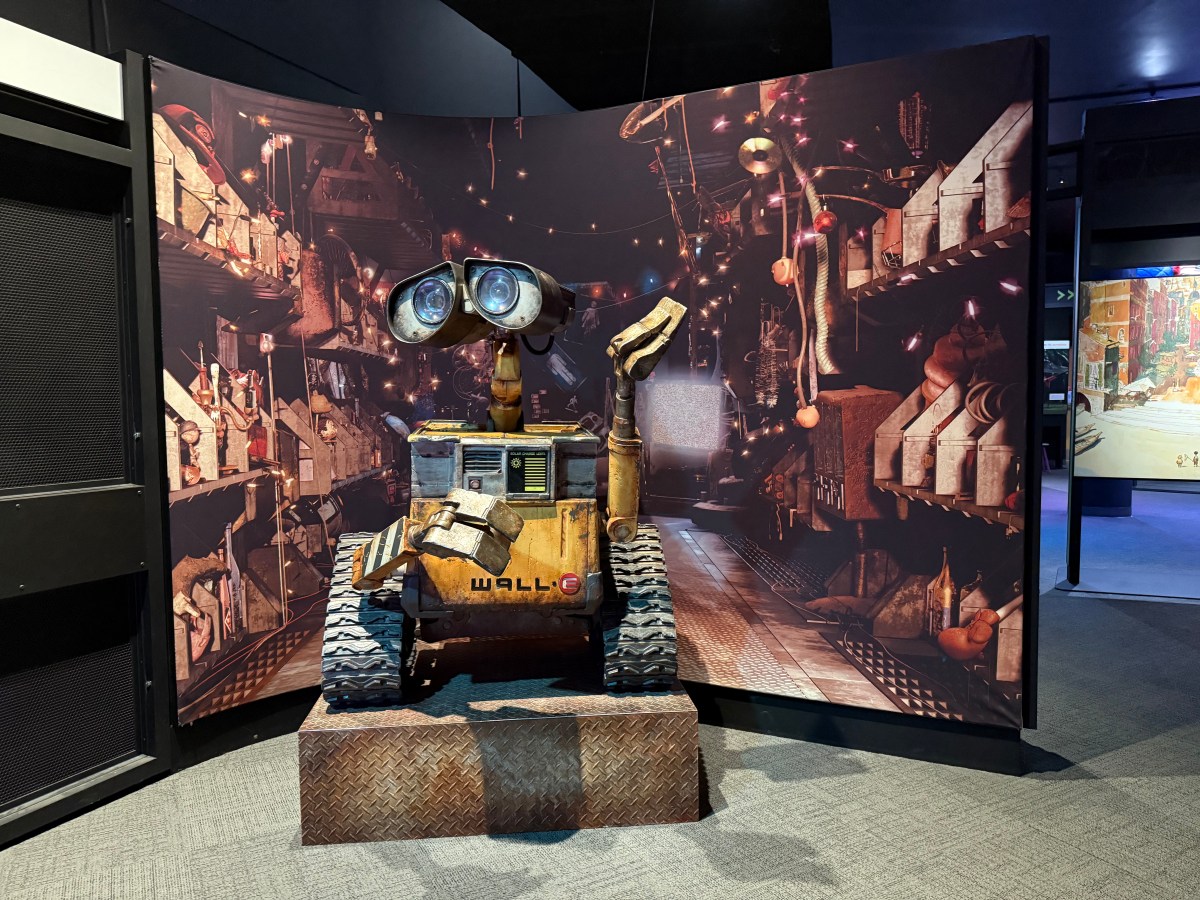
  • Design a robot friend for WALL-E by using magnetic body parts to experiment with how minor changes can impact storytelling.
  • Adjust lighting on a set from “Up” to see how color and brightness can create entirely different moods.
  • Control cameras on a large recreation of a set from “A Bug’s Life” to understand how perspective shapes the storytelling process.

These experiences provide a deeper appreciation for the technological brilliance and artistic creativity that go into Pixar’s films.

Selfies with your Pixar pals

The exhibit also delivers unforgettable photo moments with life-size recreations of fan-favorite characters. Snap selfies with Buzz Lightyear, Sulley, Mike, Dory, Nemo and WALL-E. These vibrant displays are perfect for Pixar fans of all ages and make for incredible keepsakes.


STEM meets storytelling

Pixar’s magic lies in its ability to merge science and creativity, and this exhibit captures that fusion perfectly.

“As Pittsburgh’s most-visited museum, the Science Center strives to connect visitors of all ages with science that ignites curiosity that endures for a lifetime,” Carnegie Science Center Director Jason Brown said in a news release.

Why you should go

Whether you’re a long-time Pixar fan, a STEM enthusiast or simply curious about how animated movies are made, “The Science Behind Pixar” offers something for everyone. It’s an eye-opening, hands-on exploration of the meticulous processes behind the films that have touched our hearts for decades.

Its run was extended for a few more weeks! Don’t miss your chance to explore this one-of-a-kind exhibit before it closes on Jan. 26.

Kennywood’s Racer gets final farewell … for now

Blending old and new in an amusement park probably isn’t easy.

And it’s especially not easy at Kennywood, where Pittsburghers aren’t always up for change.

But as the park preserves its past, routine maintenance is necessary.

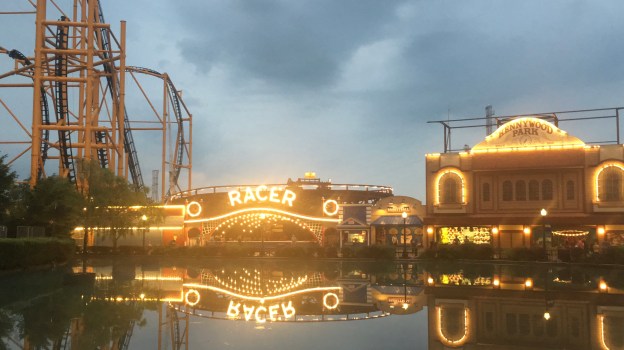
And, as such, the park’s 96-year-old, only-one-left-in-America Racer won’t open for Kennywood’s Phantom Fall Fest.

Its last day was Sept. 16.

In a blog post, Kennywood explains that the roller coaster’s lift hills need replaced and retracked. More than 1,000 feet of lumber will be used. The work will be completed by the park’s in-house team.

“They’ll start with the left lift hill this year, followed by the right lift hill next year,” Mark Frazee, Kennywood’s content manager, wrote in the post.

Of course, it’s not Kennywood’s only restoration project this offseason.

In August, the park announced that the Turtle would undergo extensive off-season work.

And, Kennywood returned the Kangaroo to the park, adding to its “commitment to preserving the park’s past while moving toward the future.”