Category Archives: newspapers

What is Pittsburgh without the Post-Gazette?

Like sands through the hourglass… the drama around the impending death of the Pittsburgh Post-Gazette just keeps getting more convoluted.

On Jan. 7, Block Communications dropped a bomb on the region: The Pittsburgh Post-Gazette — a newspaper that’s been part of this community’s civic fabric for nearly 240 years — will publish its final edition May 3, and the entire operation will cease to exist.

This isn’t just another checkmark in the long casualty list of American journalism. This is the newspaper that defined reporting in Pittsburgh, that held power accountable and that offered depth few outlets even attempt anymore.

And soon, it will be gone.

How did the PG get here?

In July 2020, the Post-Gazette declared an impasse in contract negotiations with the Newspaper Guild of Pittsburgh and unilaterally altered employees’ terms of employment, including health care. (Federal labor authorities later ruled those actions violated labor law.)

That decision sparked a newsroom strike on Oct. 18, 2022, that stretched on for more than three years, officially ending Nov. 13, 2025. PG journalists had been without a contract since 2017.

More recently, a federal appeals court upheld a ruling requiring the company to honor its labor obligations. Block Communications sought a stay from the U.S. Supreme Court. When the justices refused to grant it, the company chose closure over compliance.

The scramble to save something — anything

Since the Blocks refused to comply with the ruling, local groups and individuals have announced a flurry of plans — to expand coverage, remind readers they exist, build something new or attempt to acquire PG assets to keep something alive.

Nearly 50 newsroom staffers who did not strike have called for new union elections and proposed either saving the paper or starting a new one.

Those 49 staffers appear ready to bend the knee. “In today’s media landscape, we must be realistic, not idealistic,” they wrote collectively, adding that they want to “change the tone of our union’s relationship with the Post-Gazette.” Because that has ever worked well for unions.

In a separate effort, former Penguins executive Kevin Acklin is attempting to line up investors to convert the Post-Gazette into a nonprofit newsroom. In an interview with Axios Pittsburgh, Acklin said he had a “good opening conversation” with Allan Block, CEO of Block Communications.

“We feel strongly that converting to a nonprofit is a very attractive alternative to shutting down the Post-Gazette,” Acklin said. “I am hopeful the present ownership group recognizes the importance of the paper to the ongoing vitality of our city.”

His full letter to Block was published in a WESA story.

Meanwhile, the Newspaper Guild of Pittsburgh has launched its own initiative — Pittsburgh Alliance for People-Empowered Reporting, or PAPER — aimed at carrying forward the spirit of PG journalism outside Block ownership. The union recently held a virtual meeting that it says drew 145 attendees, despite technical hiccups.

“You made it very clear that you’re eager for an alternative to the Block-owned PG — for something that authentically connects our communities and better reflects the concerns of working-class people,” the guild wrote in a follow-up message. The group plans a public launch in the coming days.

And if all of that weren’t enough, the Tribune-Review announced it will launch a weekend “Pittsburgh” print edition starting May 9. A weekly printed summary of news is not a daily newsroom embedded in the region it serves. Trib staffers are already stretched thin covering Westmoreland County, the Alle-Kiski Valley and whatever drives clicks online.

(Also: why this wasn’t launched before the PG’s closure is anyone’s guess — and speaks volumes.)

A fractured news ecosystem

Pittsburgh won’t technically become a “news desert” when the Post-Gazette closes. There are other news outlets — and operations masquerading as news outlets — that all provide some level of journalism or information sharing.

Public Source. Next Pittsburgh. Pittsburgh Magazine. CityCast Pittsburgh. Pittsburgh Jewish Chronicle. Pittsburgh Business Times. Axios Pittsburgh. Plus television and radio: KDKA-TV, WTAE, WPXI, WESA and KDKA Radio.

None of them offers the depth, breadth or daily accountability journalism the Post-Gazette once provided. Some, in fact, often rely on the PG for their own reporting.

That fragmentation has been happening for years as the paper downsized following circulation cuts, ad revenue losses and Block dysfunction: Suburban weeklies reduced to ad circulars, websites with little original reporting, influencer feeds posing as news, PR firms pushing spin, communications teams rebranded as “content creators.”

You already have to work to find real reporting on Pittsburgh and Allegheny County. Removing the Post-Gazette doesn’t simplify the ecosystem — it makes it harder.

The PG’s decline also mirrors a national trend. Locally, the region has lost countless newspapers that once covered suburban communities, school boards and borough councils. With those losses went community calendars, nonprofit announcements and everyday civic information.

People used to look in one place to understand what was happening around them. Now they must subscribe to a patchwork of newsletters, Facebook groups and alerts — and still get less news.

Newspapers helped build community

“The local newspaper not only informs citizens but also helps build community among its readers,” Andrew Conte wrote in his 2022 book, “Death of the Daily News: How Citizen Gatekeepers Can Save Local Journalism,” which examined the closure of the McKeesport Daily News.

Conte references political scientist Robert Putnam’s “Bowling Alone: The Collapse and Revival of American Community,” which argues that social capital — networks of trust and civic participation — has been eroding for decades. Putnam also found a link between newspaper readership and civic engagement.

Without newspapers, it becomes harder for people to share information, build trust and participate meaningfully in public life.

The trance we didn’t notice

Conte also cites media theorist Marshall McLuhan, who warned about society’s failure to recognize how new media reshape behavior.

“If we continue in our self-induced subliminal trance, we will be their slaves,” McLuhan said, referring to electronic media of the time — notably, television.

He died in 1980, three years before the internet.

Apply that logic to cable TV, video games, computers, smartphones, streaming, social media — and now AI. There may never have been a moment more hostile to shared facts and verified information than now.

A less informed public and fractured communities create fertile ground for misinformation, distrust and apathy. Chaos.

This isn’t nostalgia

I love news. I love newsrooms.

But this isn’t nostalgia. It’s a sober assessment from someone who’s worked in journalism and understands what quality reporting actually looks like — as both a journalist and a reader.

Pittsburgh’s civic discourse — what we know, what we debate, who we hold accountable — is poorer without its paper of record. In May, we’re going to find out just how much poorer.

Everything in life is only for now

I’m not the first, and I won’t be the last.

The end of 2022 will mark a first in my professional career: I will no longer be a full-time journalist.

That’s not an easy sentence to complete and an even more difficult one to process. Journalism has been the only career I’ve ever envisioned.

When fellow elementary school students dreamed of being astronauts or gymnasts or doctors or presidents, I wanted to be a reporter.

In middle school and high school, as sciences and math were increasingly pushed, I pushed back and focused on writing, journalism and communications courses.

This sounds cliche, but I was first drawn to news for its ability to share important information people needed to know.

Newspapers, at the time, were stuffed full of so much valuable information.

I would lose track of time reading the Sunday edition of the Pittsburgh Post-Gazette — back when it seemed thicker than an encyclopedia. And I always found myself focused on local and regional stories — stories that had an impact or were of interest to areas I lived in or near.

I read the then-Moon Record from front to back — a newspaper that’s related publications would later have a profound impact on my career and life.

I was also drawn to news for its sense of immediacy and that rush of adrenaline when breaking news happens, watching television reporters and anchors bring information to people in real time.

While news stories were of interest to me, so was understanding the art of making news — whether it be for print, television, radio or, later, digital.

To this day, I consume the information while also analyzing the coverage. Ask anybody who has ever watched a newscast with me, and they’ll tell you how enjoyable (my word, not theirs) it is to hear me discuss the coverage.

As a kid, I can remember many times writing “stories” about and anchoring “newscasts” to my stuffed animals. I would even make “incidents” happen in my Micro Machines setups to have newspeople go cover.

Outside of interviewing toys, my first major interview was then-Pittsburgh Steelers kicker Gary Anderson, who I tracked down in an elementary school office following an assembly. I was in third grade.

In high school, my principal threatened to keep me from walking at graduation following the publication of an editorial I wrote that he disagreed with.

As a journalist in college, I helped tackle a groundbreaking legal case of a college nun who sued a Catholic university over sexual discrimination. I helped to uncover sources that were quoted by The New York Times.

My time at the Pittsburgh Tribune-Review allowed me to live out those childhood dreams of sharing stories that mattered to communities and families through the Sewickley Herald and The Signal Item — two newspapers I will forever be grateful to have been part of.

For the last few years with Hearst Television, I have had the responsibility of managing a team tasked with copy editing news and media content across more than two dozen local news digital platforms.

And while it is incredibly difficult to step away from what has long felt like a calling, it was time.

The coronavirus pandemic has allowed me to refocus my life and do something I’ve never done before: Put myself and my life first.

It’s not been easy to say goodbye to working full-time in news. There have been a lot of tears shed.

But I’m reminded of a line in one of my favorite musicals — “Avenue Q” — that is simple and true, and helped me to again understand that nothing is forever: “Everything in life is only for now.”

Looking at local journalism as the Sewickley Herald marks 116 years

Happy birthday, Sewickley Herald!

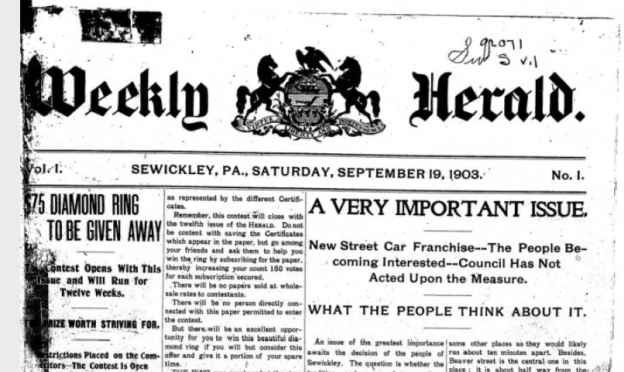
For 116 years (Sept. 19, 1903), the Sewickley Herald has served as the record keeper, fact checker and voice of the Sewickley Valley.

I played a small part in the storied history of the Sewickley Herald, serving as a reporter and then editor of the venerable weekly publication for about 11 years.

To say I loved that newspaper is an understatement. The Sewickley Herald and its core mission of providing quality news and information meant such a great deal to me.

I knew my role as a steward of that newspaper was important. Things don’t last that long without passion, pride and commitment.

In a 2013 story celebrating the 110th anniversary of the Herald, I wrote: “Founding publishers J.L. Kochenderfer and James Stinson likely had little idea of the legacy the Herald would carry with it more than a century later.”

By nature of the business, I was part of some pretty big stories impacting the Sewickley Valley — just in my short part of its legacy.

Community journalism sometimes gets a bad rap. Too often, I had then-colleagues snicker at the thought of covering hyperlocal journalism. They didn’t see the value in covering local school board meetings or road paving projects. To them, journalism was about big news in big areas with big crime.

And yet, there we were at the Sewickley Herald, covering bank robberies and business districts, middle school musicals and council members violating state ethics laws.

Thankfully, I’m bad at math, because I would not want to know how much unpaid time I put in at the Sewickley Herald (and in later years at The Signal Item in Carnegie and the South Hills Record — two papers I later became editor of at the same time as I was editor of the Sewickley Herald … doing more with far less).

As time went on, our staffs were slashed. I began with the Sewickley Herald in 2007. At the time, there was an editor (Dona Dreeland), two reporters, a sports editor and a photographer. I was a part-time reporter early on, splitting my time with the Herald and Signal Item (the two papers I would close out my Trib career as editor of).

By the end, we were a staff of an editor (me!), plus a photographer who was split in a million different directions … and a group of freelancers who I owe so much to for helping me look like I had it all together.

And somehow, we still put out quality work, covering school board meetings, student achievements, asking the tough questions and getting in all those local events and briefs.

And somewhere in there we managed to have some fun with (and win several awards for) our online presence/community, photo, news stories, feature stories and sports stories.

Stepping away from the Sewickley Herald was one of the hardest things I’ve ever done. But as much as I love the Herald, I knew it was time.

In my farewell column, I wrote, “As one of the oldest community newspapers still in operation in the region, the Sewickley Herald has documented quite a bit of change across the Sewickley Valley over the years. After all, change is news. And things always are changing.”

I’ve known and understood the role of a community newspaper for years, but I didn’t find quite the right way to articulate it until I was nearly done:

In my 2018 Herald Citizens of the Year celebration speech, I described how the role of a community newspaper is much like the role of a mother.

“The Herald is there to comfort when there is pain, question when there is conflict, and celebrate when there is joy,” I explained at that celebration. Mothers get to the bottom of disagreements between children, can tell when someone isn’t telling the truth, and know everything that happens at home even if they didn’t witness it.

– Sewickley Herald, Aug. 2, 2018

I miss local journalism. And, sadly, locally and nationally, local journalism has drastically changed just in the last year, as more companies seek to squeeze every last penny out of the success of decades old community newspapers.

I ended my 2018 farewell column with a quote from a musical (“Avenue Q”) that I think of every single day: “Everything in life is only for now.”

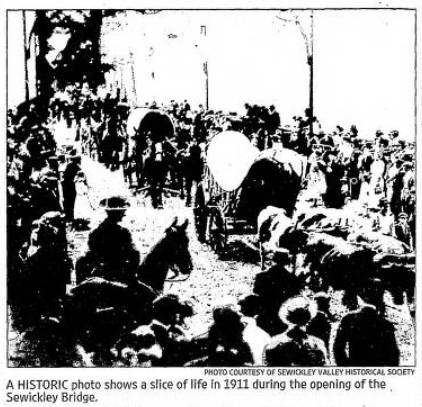
Sewickley Bridge marks 108 years

We tend to take bridges for granted in Western Pennsylvania. That is, until the span is closed.

Next year should be interesting for people who use the Sewickley Bridge, as PennDOT (finally!) will rehabilitate the span.

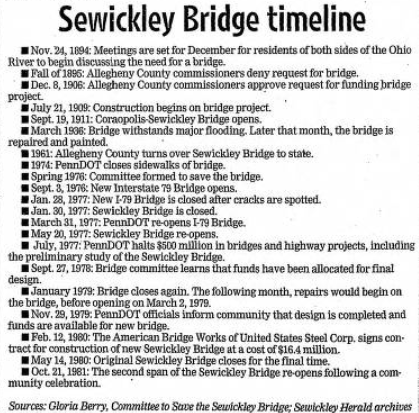
But until then, let’s celebrate the Sewickley Bridge, which turns 108 years old on Sept. 19. The current bridge that’s standing is not 108 years old. The second Sewickley Bridge opened Oct. 21, 1981.

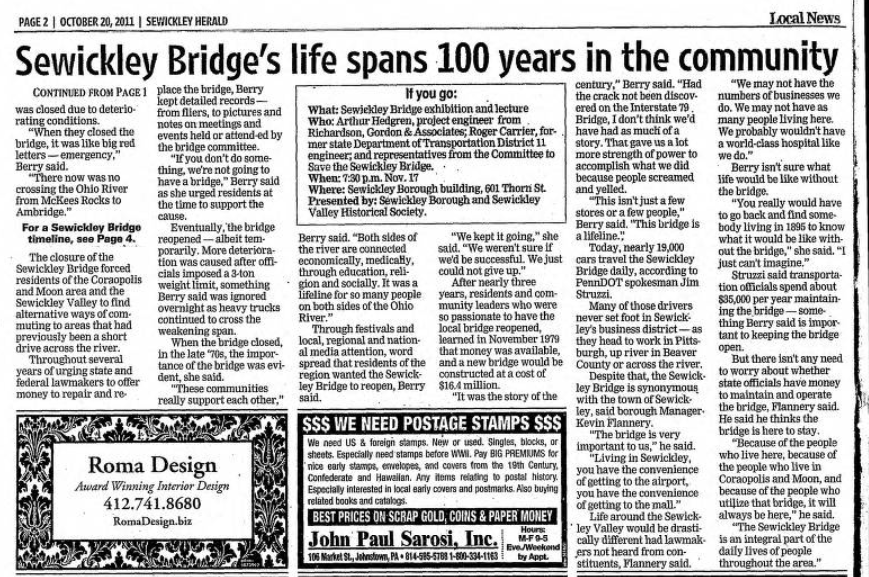
And, as I documented in a 2011 story for the Sewickley Herald, the bridge almost didn’t make it into the 1980s. PennDOT wanted to tear it down following the recent opening of the Interstate 79 Neville Island Bridge.

But Sewickley Valley residents, led by Gloria Berry, campaigned and the bridge was saved.

A tugboat crashed into the new I-79 span, leaving no crossing along the Ohio River for miles.

“When they closed the bridge, it was like big red letters — emergency,” Berry told me for the 2011 Herald story. “There was no crossing the Ohio River from McKees Rocks to Ambridge.”

The bridge is an important piece of the culture of Sewickley Valley and the Moon Township/Coraopolis area, too.

“Both sides of the river are connected economically, medicaHy, through education, religion and socially. It was a lifeline for so many people on both sides of the Ohio River,” Berry said.

At the time, PennDOT said about 19,000 vehicles cross the bridge daily.

Read more about the Sewickley Bridge in this 100th anniversary story I did in 2011 for the Sewickley Herald. You can search the Sewickley Herald archives on the Sewickley Public Library website.

Note: I worked at the Sewickley Herald from about 2007 through August 2018.