Tag Archives: history

Pittsburgh is on the clock for the NFL Draft, and it’s about time

The NFL Draft coming to Pittsburgh is exciting for a lot of reasons.

There’s the football, of course. There’s the national attention. There’s the chance to welcome fans from across the country to a city that knows a thing or two about the game.

But more than anything, the draft gives Pittsburgh a chance to show people who we are now.

For too long, too many people have held onto an outdated image of Pittsburgh — smoky skies, steel mills and a city stuck in the past. That history matters. It shaped us. It gave this region its grit, its work ethic and its identity.

But Pittsburgh is not a smoggy old mill town waiting to be rediscovered.

We’ve been here all along.

And when the NFL Draft brings visitors, media and football fans to town, they’re going to see a city that is beautiful, lively and full of things to do.

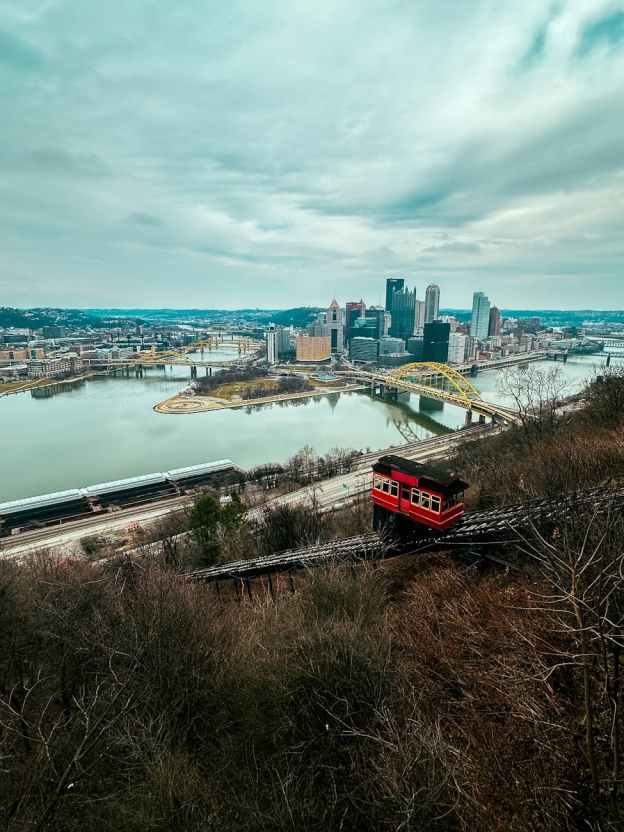
They’ll see our rivers. They’ll see our skyline. They’ll see Downtown, the North Shore, Mount Washington and all sorts of areas that can tell the Pittsburgh story first-hand.

They’ll see a city and region that has changed without forgetting where it came from.

Downtown deserves the spotlight

Pittsburgh’s Downtown is made for a moment like this.

It’s walkable. It’s scenic. It’s packed with history, restaurants, hotels, theaters and riverfront views. You can stand at Point State Park and look out at the place where the Allegheny and Monongahela rivers meet to form the Ohio. You can walk across a bridge to the North Shore. You can look up and see hillsides rising around the city.

That’s not something every city can offer.

And for visitors coming in for the draft, Downtown will be more than a backdrop. It will be part of the experience.

They’ll be able to explore before and after events. They’ll be able to walk to restaurants, museums, bars, theaters and hotels. They’ll be able to see why so many of us love this place—even when we complain about construction, parking or which tunnel is backed up.

Because all of that makes Pittsburgh, Pittsburgh.

We’re more than steel, even if steel helped make us

Pittsburgh should never run away from its steel history or blue-collar mindset.

The mills built communities. They brought families here. They helped create the work ethic people still associate with this region.

But the mistake is thinking the story stopped there.

Today’s Pittsburgh is a city of education, medicine, technology, arts, culture, research, food, sports and neighborhoods with strong identities. It is a place where old industrial buildings have found new life, where riverfronts have become gathering places and where people still feel connected to their communities.

That’s what the NFL Draft can help show.

It can show that Pittsburgh’s past is important, but it is not the only thing that defines us.

Let’s talk about “eds and meds”

People like to use the phrase “eds and meds” when they talk about Pittsburgh’s modern economy.

It can sound a little too simple, but there’s truth behind it.

Our universities, hospitals and research institutions have helped carry this region into a new era. They bring students, doctors, nurses, researchers, professors, patients, families and workers into Pittsburgh from all over the world.

Our museums are worth the trip

Pittsburgh also has museums that deserve national attention.

The Carnegie Museums of Pittsburgh are one of the region’s great cultural assets. Carnegie Museum of Art, Carnegie Museum of Natural History, Kamin Science Center and The Andy Warhol Museum give visitors a little bit of everything — art, science, history, dinosaurs, innovation and one of Pittsburgh’s most famous creative voices.

The Heinz History Center tells the story of Western Pennsylvania in a way that helps people understand how this region grew, changed and contributed to the country.

And Phipps Conservatory and Botanical Gardens is one of the most beautiful places in the city. It is a reminder that Pittsburgh is greener, brighter and more alive than outsiders sometimes expect.

These are places that make Pittsburgh richer. They give families, students, visitors and longtime residents reasons to keep learning and exploring.

Don’t forget the libraries

Pittsburgh is also a library city.

The Carnegie Library of Pittsburgh system is one of the city’s most important civic resources. Its branches serve neighborhoods across the city and offer far more than books. They offer programming, public space, internet access, job resources, children’s activities and a place for people to gather.

Across the county, the Allegheny County Library Association and the network of suburban libraries do the same kind of work.

Libraries are one of the best measures of a community’s priorities. In Pittsburgh and Allegheny County, they remain vital pieces of public life.

When visitors come here, they may notice the stadiums first. That’s fine. They’re hard to miss.

But part of what makes Pittsburgh special is that our pride extends beyond sports. It includes the places that help people read, learn, connect and grow.

The arts are part of the city’s heartbeat

Let’s not forget about Pittsburgh’s arts scene.

The Cultural District has helped make Downtown a destination for theater, music, dance and public art. The Pittsburgh Cultural Trust has been a major part of that transformation.

Pittsburgh CLO brings musical theater to generations of audiences. Heinz Hall remains one of Downtown’s great landmarks and the home of the Pittsburgh Symphony Orchestra. The Benedum Center, Byham Theater and other venues help keep the city’s arts scene active year-round.

This is another part of Pittsburgh that surprises people.

They come expecting sports. They find theater, music, dance, galleries, festivals and public art.

That combination is what makes the city interesting. You can go from a football game on the North Shore to a show Downtown in the same night. You can spend one day at a museum and the next at Kennywood.

There’s plenty of fun here, too

Speaking of Kennywood, the isn’t limited to Downtown and the city’s limits.

Kennywood is one of the great Pittsburgh traditions. Generations of families have gone there for roller coasters, Potato Patch fries and summer nights that feel like childhood.

Just down the road from Kennywood, its water park, Sandcastle, gives the region a place to cool off along the Monongahela River. (Not in, though — let’s make that distinction, haha.)

And about an hour away from Kennywood is sister park Idlewild, which is part of the Western Pennsylvania family tradition, especially for younger kids and parents who want a day that feels a little slower and a little sweeter. Daniel Tiger and his friends are among the main attractions at Idlewild.

This is Pittsburgh’s moment

The NFL Draft will bring attention to Pittsburgh.

That is good for the city. It is good for restaurants, hotels, small businesses and attractions. It is good for the people who have been saying for years that Pittsburgh deserves more credit than it gets.

But the most exciting part is not just that people will come here, it is that they will see a city with three rivers, great neighborhoods, strong institutions, beautiful parks, serious culture and a sense of identity that cannot be — dare I say — manufactured.

They will see that Pittsburgh is not stuck in the past.

They will see that we are proud of where we came from and excited about where we are going.

And maybe, after a few days here, they’ll understand what we already know: Pittsburgh is a great place to visit, a great place to explore and a great place to call home.

Sewickley Bridge marks 108 years

We tend to take bridges for granted in Western Pennsylvania. That is, until the span is closed.

Next year should be interesting for people who use the Sewickley Bridge, as PennDOT (finally!) will rehabilitate the span.

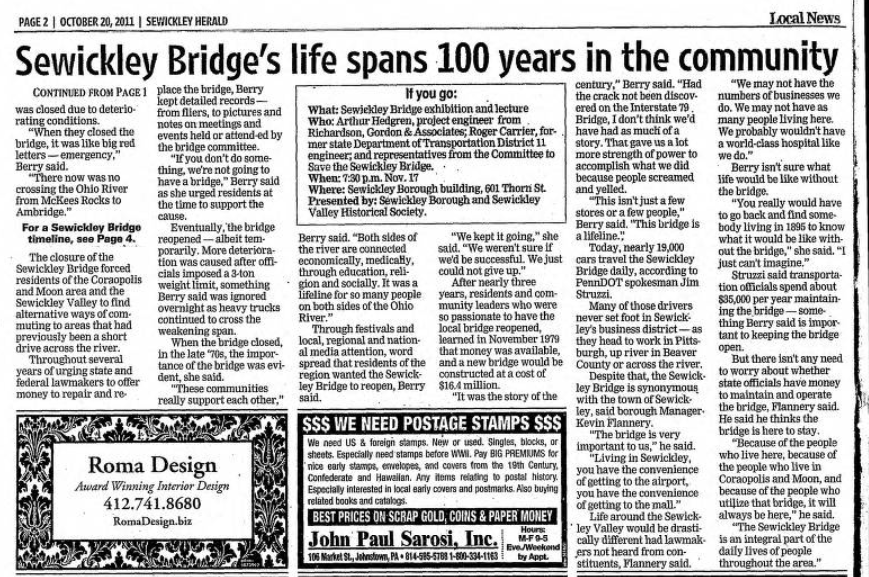
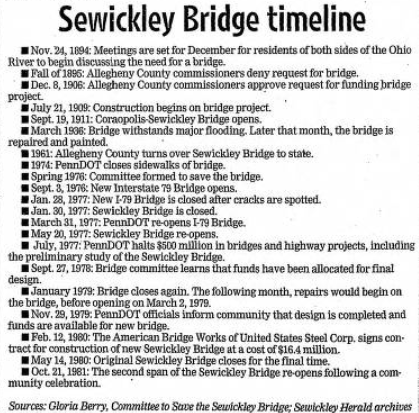
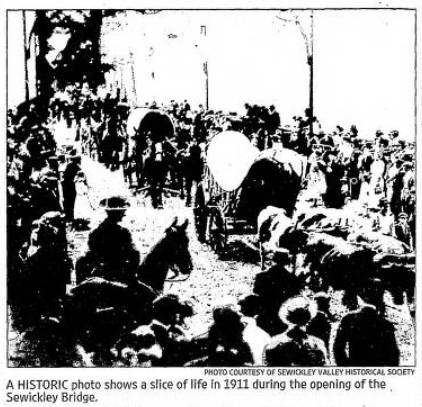
But until then, let’s celebrate the Sewickley Bridge, which turns 108 years old on Sept. 19. The current bridge that’s standing is not 108 years old. The second Sewickley Bridge opened Oct. 21, 1981.

And, as I documented in a 2011 story for the Sewickley Herald, the bridge almost didn’t make it into the 1980s. PennDOT wanted to tear it down following the recent opening of the Interstate 79 Neville Island Bridge.

But Sewickley Valley residents, led by Gloria Berry, campaigned and the bridge was saved.

A tugboat crashed into the new I-79 span, leaving no crossing along the Ohio River for miles.

“When they closed the bridge, it was like big red letters — emergency,” Berry told me for the 2011 Herald story. “There was no crossing the Ohio River from McKees Rocks to Ambridge.”

The bridge is an important piece of the culture of Sewickley Valley and the Moon Township/Coraopolis area, too.

“Both sides of the river are connected economically, medicaHy, through education, religion and socially. It was a lifeline for so many people on both sides of the Ohio River,” Berry said.

At the time, PennDOT said about 19,000 vehicles cross the bridge daily.

Read more about the Sewickley Bridge in this 100th anniversary story I did in 2011 for the Sewickley Herald. You can search the Sewickley Herald archives on the Sewickley Public Library website.

Note: I worked at the Sewickley Herald from about 2007 through August 2018.

Memories from Kaufmann’s Clock

This slideshow requires JavaScript.

I was deeply saddened to learn Downtown Pittsburgh’s last major anchor department store soon will be nothing but a memory.

After about 128 years in the same location at 400 Fifth Ave., Macy’s will close the iconic Downtown Pittsburgh store which first opened in 1887 as Kaufmann’s. The company made the announcement July 13, 2015.

For decades, the Downtown location stood out for its valued traditions: Christmas window displays, visits with Santa, a holiday parade, the Arcade Bakery, the Tic Toc restaurant and much more.

Generations of Pittsburghers have met under Kaufmann’s Clock, too.

Because of Macy’s commitment to retaining a Downtown Pittsburgh store after the company bought The May Co. — the longtime parent company of regionalized department stores such as Kaufmann’s, Filene’s (Boston) and Marshall Field’s (Chicago) — we were afforded a chance to continue making memories — albeit under the Macy’s nameplate for the last nearly nine years.

But soon, like Horne’s and Gimbels before it, the Kaufmann’s and Macy’s names will disappear from the Downtown Pittsburgh retail landscape.

While there is much to discuss about how and why the company made this decision to close Pittsburgh’s last large anchor store, and on the Downtown retail climate as a whole, I want to solely focus on memories.

I didn’t grow up in a time when people flocked Downtown to Fifth Avenue and nearby streets to shop at Gimbels, Horne’s, Kaufmann’s or Jenkins Arcade — the way my mom recalls doing with her family.

It wasn’t until I moved away from Pittsburgh that I realized how special Downtown Pittsburgh’s Kaufmann’s — later Macy’s — was.

Creaky floors, the Westinghouse elevators and wooden escalators gave so much charm to the mundane task of shopping for clothing. Having lunch at the Tic Toc restaurant and grabbing thumbprints at Arcade Bakery are things shoppers can’t do at Ross Park Mall or the Mall at Robinson or any suburban mall Macy’s.

There aren’t window displays at the South Hills Village Macy’s with whimsical holiday scenes.

In a world of corporate sameness, the Macy’s in Downtown Pittsburgh added uniqueness.

Light Up Night and those holiday windows
Light Up Night is one of my most favorite days of the year. For the last several years, I’ve taken the day off work and have headed into Downtown Pittsburgh in the afternoon to begin celebrating the kickoff to the holiday season.

Part of that holiday spirit included window displays at Kaufmann’s (and later Macy’s). With so much to do Downtown that evening, I’ve only had one chance to watch the unveiling of the windows.

It was 2013. Gloria Gaynor performed and Pirates manager Clint Hurdle spoke.

Then, the throngs of people in attendance began counting down until the bright red curtains were pulled off to usher in another season of holiday cheer, and a new generation of Pittsburghers created memories.

The last several years, Macy’s has placed the same displays in windows for passersby. But they’ve had a local feel: skaters at PPG Place, shoppers under the Kaufmann’s Clock, fireworks celebrating First Night.

In one window, a child was shown watching black and white footage (from “Miracle on 34th Street”) of the Macy’s Thanksgiving Day Parade on an old television as a Macy’s elf balloon moved overhead. Out of the window in the room where the child was, onlookers could see an image of Pittsburgh’s three sister bridges.

And, of course, Virginia’s mission to help write letters to Santa was prominently displayed in another window.

Several years back, I purchased from a seller on eBay four papier-mâché-type carolers once used in a Kaufmann’s window display. I’ve yet to showcase them at Christmas time, instead keeping them safely packaged away.

Speakers above the windows on Smithfield Street likely won’t play holiday tunes this year. Lights won’t shine down on whimsical displays showcasing some of Pittsburgh’s most beloved landmarks. No musician will sing and no crowd will count down. There will be no window encouraging passersby to believe.

Just taste those thumbprint cookies at Arcade Bakery
As Pittsburgh bakeries go, Arcade is top notch.

Whenever I visited the bakery, there always was a crowd: Downtown office workers picking up cakes and lunch, families taking home thumbprint cookies, husbands sipping a Coke and eating a doughnut while their wives shopped.

I always ended up with plenty of their thumbprint cookies. These sweet treats offered a generous amount of icing and came with or without jimmies (chocolate or rainbow).

Their cakes and doughnuts were just as wonderful. No mass-produced product at a big-box grocery store could compete. Only one other locally owned bakery could compete and that place closed in the late 2000s.

“Meet me under Kaufmann’s Clock”
I’ve met up with a few people over the years under Kaufmann’s Clock.

I once drove by as a bride and groom were having pictures taken with the clock.

But one of my most favorite memories of the clock was in May 2013 — the 100th anniversary of the iconic timepiece.

Macy’s hosted a weekend-long celebration with special items and a block party on Smithfield Street.

Spending the day with my mother shopping Downtown, having lunch at Tic Toc and taking home Arcade treats made that day extra special. We’ve shopped at the Downtown store at other times, but that day was special.

As we ate at Tic Toc, my mother reminisced of the days she would shop at Kaufmann’s and Gimbels (she apparently wasn’t much of a Horne’s shopper).

More than memories
Along with the charm of the structure, the thumbprint cookies, the clock and slow elevators, I was drawn to the Downtown Pittsburgh store because of its employees, selection and organization.

A few workers on the men’s floor would recognize me as I browsed. One remembered items I previously purchased and asked how the pants or shirts were.

My mother would wait in a long line for a specific employee on the woman’s floor simply because the worker was extremely outgoing and friendly. The worker once recognized me in another business in the city.

Racks of clothing were organized neatly by size and style, and the large floors allowed for ample space — unlike suburban Macy’s, where clothing is in disarray, and racks are piled close to one another to get as much on the floor as possible.

Clock keeps ticking
Before Macy’s announced the closing, I was excited for what the Big Store — once the nickname of the Downtown Kaufmann’s building — would become.

Macy’s was to occupy the first four floors with a hotel and apartments above that.

In news stories published following Macy’s announcement, the building developer said the company was surprised the retail store was backing out of the project.

A Macy’s executive — in a prepared statement — said the department store’s departure would allow for a “holistic” project.

It seems as though retail will be sought for some portion of the lower levels where Macy’s would have been. Perhaps there is a chance for the Tic Toc and Arcade Bakery to find new life in this new plan?

While department store shoppers won’t browse clothing racks, grab a bite to eat or take home a dozen thumbprints any longer at the corner of Fifth and Smithfield in Downtown Pittsburgh, Kaufmann’s Clock will continue to tick just as it has done for more than a century, ushering in new memories for dwellers.

I’ll hold close my memories of Arcade thumbprints, Christmas window displays and shopping bags under Kaufmann’s Clock.