Category Archives: journalism

You should care more about the Nexstar/Tegna merger than you do

You should care more about the Nexstar/Tegna merger than you do because it will have an impact on you — and it won’t be good.

A friend who still works in news texted me this morning after the Nexstar/Tegna merger news: “You got out at the right time.”

I had already been talking with two other friends about the merger — one who works in news and one who also got out — when she messaged that.

Her words really struck me. Leaving journalism is something I wrestle with far too often.

I miss following stories that actually affected people’s lives — directly and indirectly, and in ways they did not even realize.

I miss knowing more than the average person about what was happening in local government, in schools, in neighborhoods, on roads people drive every day.

I miss asking elected officials very basic questions and watching them get annoyed that someone was paying attention.

I miss all of what news was.

I left full-time journalism at the end of 2022.

At the time, I was working for a television news company, but none of this happened overnight. I had seen the shift starting years earlier — even a decade earlier — as people became more hostile toward local news and as newsrooms slowly started prioritizing things other than the news itself. For me, 2020 felt like a tipping point. That is when everything already in motion seemed to move into overdrive.

Important news was still getting covered. Real journalism was still happening.

But as attention spans waned and eyeballs wandered to other forms of media (like TikTok, Instagram, YouTube), the draw to make headlines more sensational, videos shorter with less information and more gimmicks only intensified.

And it was not just happening in TV. It was happening everywhere.

There appeared to be less emphasis on actually informing people and more emphasis on feeding the machine.

More and more news outlets were referring to news as “content.” And that “content” included links to Amazon products, useless user-submitted photo galleries, rewritten news releases and archived video made to look like something new.

And, I need to note, good journalism is still out there. People are still fighting to do quality journalism every day.

But too much of it is buried under junk, largely driven by the powers that be (typically, people who just have money to buy a news outlet or a few and have no actual concern about the news — or people being driven by those demands).

Maybe my friend is right. Maybe I did get out at the right time.

But I still go back and forth. Some days, I feel like I let news down by leaving. Other days, I know I was protecting myself by stepping away from a fight that already felt lost.
Everything in life is only for now

I’m not the first, and I won’t be the last.

The end of 2022 will mark a first in my professional career: I will no longer be a full-time journalist.

That’s not an easy sentence to complete and an even more difficult one to process. Journalism has been the only career I’ve ever envisioned.

When fellow elementary school students dreamed of being astronauts or gymnasts or doctors or presidents, I wanted to be a reporter.

In middle school and high school, as sciences and math were increasingly pushed, I pushed back and focused on writing, journalism and communications courses.

This sounds cliche, but I was first drawn to news for its ability to share important information people needed to know.

Newspapers, at the time, were stuffed full of so much valuable information.

I would lose track of time reading the Sunday edition of the Pittsburgh Post-Gazette — back when it seemed thicker than an encyclopedia. And I always found myself focused on local and regional stories — stories that had an impact or were of interest to areas I lived in or near.

I read the then-Moon Record from front to back — a newspaper that’s related publications would later have a profound impact on my career and life.

I was also drawn to news for its sense of immediacy and that rush of adrenaline when breaking news happens, watching television reporters and anchors bring information to people in real time.

While news stories were of interest to me, so was understanding the art of making news — whether it be for print, television, radio or, later, digital.

To this day, I consume the information while also analyzing the coverage. Ask anybody who has ever watched a newscast with me, and they’ll tell you how enjoyable (my word, not theirs) it is to hear me discuss the coverage.

As a kid, I can remember many times writing “stories” about and anchoring “newscasts” to my stuffed animals. I would even make “incidents” happen in my Micro Machines setups to have newspeople go cover.

Outside of interviewing toys, my first major interview was then-Pittsburgh Steelers kicker Gary Anderson, who I tracked down in an elementary school office following an assembly. I was in third grade.

In high school, my principal threatened to keep me from walking at graduation following the publication of an editorial I wrote that he disagreed with.

As a journalist in college, I helped tackle a groundbreaking legal case of a college nun who sued a Catholic university over sexual discrimination. I helped to uncover sources that were quoted by The New York Times.

My time at the Pittsburgh Tribune-Review allowed me to live out those childhood dreams of sharing stories that mattered to communities and families through the Sewickley Herald and The Signal Item — two newspapers I will forever be grateful to have been part of.

For the last few years with Hearst Television, I have had the responsibility of managing a team tasked with copy editing news and media content across more than two dozen local news digital platforms.

And while it is incredibly difficult to step away from what has long felt like a calling, it was time.

The coronavirus pandemic has allowed me to refocus my life and do something I’ve never done before: Put myself and my life first.

It’s not been easy to say goodbye to working full-time in news. There have been a lot of tears shed.

But I’m reminded of a line in one of my favorite musicals — “Avenue Q” — that is simple and true, and helped me to again understand that nothing is forever: “Everything in life is only for now.”

Twitter’s demise leaves users in disarray

How about Twitter these days?

I’ve always enjoyed social media and the information sharing, community building and friendships that has come with it.

Before we knew what “social media” was, I was connecting via blog writing and AOL chat rooms. In the early 2000s, I made digital friends via blogging. Then MySpace, then Facebook, then Twitter.

As a journalist and community builder, finding ways to engage, build relationships and share information runs central to who I am.

Twitter, by far, has had the most impact on my digital life and, quite honestly, my real life.

I used to enjoy saying, “Most of my friends are from Twitter.” And it was true!

Before most journalists knew what Twitter was, I was already finding sources and searching for story ideas via tweets. Over the course of several years, I taught fellow journalists to use Twitter.

As time went on and more people began using Twitter, the social media site went from a thoughtful cafe to a rowdy bar. I still found community, but finding and keeping those strong connections took more effort — like trying to move through a crowded bar and shout, “WHAT DID YOU SAY?” each time your friend says something. You know the scene.

From a news perspective, Twitter has been nothing more than a vacuum of people whose thoughts and words mean very little off the platform.

But with the real-time demise of Twitter, people are jumping ship and seeking new places to set up digital residences.

I dusted off my Reddit and Discord accounts; I tried navigating my way into an account on Mastodon; I opened accounts on Tribel, Cohost, and counter.social; and even considered giving LinkedIn more of a shot.

I’m not sure what my end game is — except that I plan on using Twitter less often.

I may go retro and blog more (here or maybe on Substack).

Perhaps you’ll consider following along. Find all the links here.

‘I don’t have to apologize for letting go or choosing things in the name of my peace and healing’

I did something this week that was long overdue: I stepped away from all of my volunteer and extracurricular activities.

I stepped back from volunteering* with an organization I’ve been heavily involved with for more than 25 years.

I officially resigned from a nonprofit board position, stepped back from a few other nonprofits where I’ve offered assistance or volunteered and said no to some recent asks for my help in other activities.

And it feels good.

(Continue reading below the Instagram post.)

Being forced last year to pause so much helped me take a hard look at what I was spending my life doing. Like a lot of you, I said “yes” far too much.

I’ve been going hard at volunteering for nonprofits for way too long. For many years, I tried to keep track of my hours spent volunteering and I easily racked up anywhere from 1,800 to 2,600 hours a year volunteering.

I’ve put so much time in, and I just needed to take a break — something I’ve been trying to do for a few years now. But every time I found myself with extra time, I found some nonprofit group or activity to fill its void. I’ve said “yes” too often just thinking it would be a simple ask, and it usually wasn’t.

The ongoing global pandemic has taught me that I need to slow down and live my life.

The nonprofit groups will continue. The other activities will go on.

When I’m ready, I’ll find my way back into volunteering — either for groups I’ve recently hit pause on or new endeavors.

There’s a song from one of the greatest musicals — “Avenue Q” — that I often am reminded of: “For Now.” The lyrics go: “Nothing lasts. Life goes on, full of surprises. … Except for death and paying taxes, everything in life is only for now.” This pause is only for now.

What led me to this decision that, from the outside, seems drastic? As I said earlier, it’s been a long time coming. When doing any kind of volunteering, I think of another “Avenue Q” song that goes: “When you help others, you’re really helping yourself.” Helping nonprofit groups began to feel like tasks mounting with no end in sight — and I started to feel as though I wasn’t helping myself.

A friend suggested that nonprofit work should still — at the core — be fun and fulfilling.

The other day, I ran across a post on Facebook with the quote posted above. I found Yasmine Cheyenne’s Instagram account to give her proper credit. But that quote (“I don’t have to apologize for letting go or choosing things in the name of my peace and healing”) really resonated with me. It’s OK to let go.

* Besides, did you really think I could completely step away? I’m still going to raise some money for the American Cancer Society because I signed up as a team captain and don’t want to have a zero-dollar team. But I’m going to do it with as little effort this year. And I still plan to help with a journalism group.

Of course, with an ongoing pandemic, there is little to fill this large chunk of time with. And maybe that’s for the best for now.

Looking at local journalism as the Sewickley Herald marks 116 years

Happy birthday, Sewickley Herald!

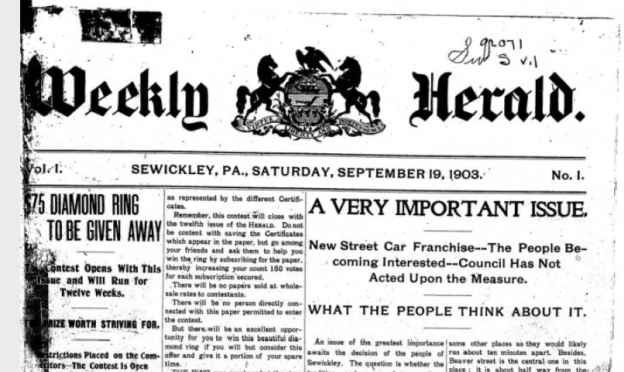
For 116 years (Sept. 19, 1903), the Sewickley Herald has served as the record keeper, fact checker and voice of the Sewickley Valley.

I played a small part in the storied history of the Sewickley Herald, serving as a reporter and then editor of the venerable weekly publication for about 11 years.

To say I loved that newspaper is an understatement. The Sewickley Herald and its core mission of providing quality news and information meant such a great deal to me.

I knew my role as a steward of that newspaper was important. Things don’t last that long without passion, pride and commitment.

In a 2013 story celebrating the 110th anniversary of the Herald, I wrote: “Founding publishers J.L. Kochenderfer and James Stinson likely had little idea of the legacy the Herald would carry with it more than a century later.”

By nature of the business, I was part of some pretty big stories impacting the Sewickley Valley — just in my short part of its legacy.

Community journalism sometimes gets a bad rap. Too often, I had then-colleagues snicker at the thought of covering hyperlocal journalism. They didn’t see the value in covering local school board meetings or road paving projects. To them, journalism was about big news in big areas with big crime.

And yet, there we were at the Sewickley Herald, covering bank robberies and business districts, middle school musicals and council members violating state ethics laws.

Thankfully, I’m bad at math, because I would not want to know how much unpaid time I put in at the Sewickley Herald (and in later years at The Signal Item in Carnegie and the South Hills Record — two papers I later became editor of at the same time as I was editor of the Sewickley Herald … doing more with far less).

As time went on, our staffs were slashed. I began with the Sewickley Herald in 2007. At the time, there was an editor (Dona Dreeland), two reporters, a sports editor and a photographer. I was a part-time reporter early on, splitting my time with the Herald and Signal Item (the two papers I would close out my Trib career as editor of).

By the end, we were a staff of an editor (me!), plus a photographer who was split in a million different directions … and a group of freelancers who I owe so much to for helping me look like I had it all together.

And somehow, we still put out quality work, covering school board meetings, student achievements, asking the tough questions and getting in all those local events and briefs.

And somewhere in there we managed to have some fun with (and win several awards for) our online presence/community, photo, news stories, feature stories and sports stories.

Stepping away from the Sewickley Herald was one of the hardest things I’ve ever done. But as much as I love the Herald, I knew it was time.

In my farewell column, I wrote, “As one of the oldest community newspapers still in operation in the region, the Sewickley Herald has documented quite a bit of change across the Sewickley Valley over the years. After all, change is news. And things always are changing.”

I’ve known and understood the role of a community newspaper for years, but I didn’t find quite the right way to articulate it until I was nearly done:

In my 2018 Herald Citizens of the Year celebration speech, I described how the role of a community newspaper is much like the role of a mother.

“The Herald is there to comfort when there is pain, question when there is conflict, and celebrate when there is joy,” I explained at that celebration. Mothers get to the bottom of disagreements between children, can tell when someone isn’t telling the truth, and know everything that happens at home even if they didn’t witness it.

– Sewickley Herald, Aug. 2, 2018

I miss local journalism. And, sadly, locally and nationally, local journalism has drastically changed just in the last year, as more companies seek to squeeze every last penny out of the success of decades old community newspapers.

I ended my 2018 farewell column with a quote from a musical (“Avenue Q”) that I think of every single day: “Everything in life is only for now.”